
By Cesar Figueroa, Owner, ReUp Benefits
In this guide
What is PEO underwriting? PEO underwriting is the review a PEO runs before it accepts your company and sets your price. For health insurance, underwriters study your employee census: ages, locations, plan choices, claims and sometimes prescription history. For workers' comp, they study your job classes, payroll and injury history. The answer is a quote, a conditional quote or a decline.
Underwriting is where a PEO's price is really made, and it's the part most buyers never see. If you're new to how PEO coverage works, start with our guide to what a PEO is in insurance. I spent more than ten years inside three PEOs, and this is the part of the process I want every business owner to understand before they send a census.
Why does a PEO underwrite your company at all?
Because a PEO doesn't have to take you. When you buy group health insurance straight from a carrier, federal guaranteed availability rules generally require the carrier to accept any employer that applies. A PEO isn't an insurance company, so it can choose which clients join its plans, and it can say no.
Every client a PEO accepts joins a shared pool. One group with heavy claims raises costs for everyone in it, so underwriters protect the pool as a whole. Foothold America describes the risk as adverse selection: the sickest groups cluster together and drive up costs for everyone in the pool.
A PEO underwrites health insurance and workers' comp separately, and you can pass one and fail the other.

What do PEO underwriters look at for health insurance?
Health underwriting starts with your census, the employee list with ages, ZIP codes, coverage tiers and plan choices. The underwriter is trying to predict one number: what your group will cost next year.
| What they review | What it tells the underwriter |
|---|---|
| Employee ages | Older groups cost more to insure, on average |
| ZIP codes | Which carriers and networks fit, and local price levels |
| Coverage tiers | How many spouses and children the plan will cover |
| Participation | Whether enough employees enroll to spread the risk |
| Claims and renewal history | Large claims, and how fast your costs have grown |
| Prescription data or health questionnaires | Ongoing treatment that predicts future claims |
| Industry and workforce mix | Part-time share, turnover and expected use of care |
Why does age matter so much?
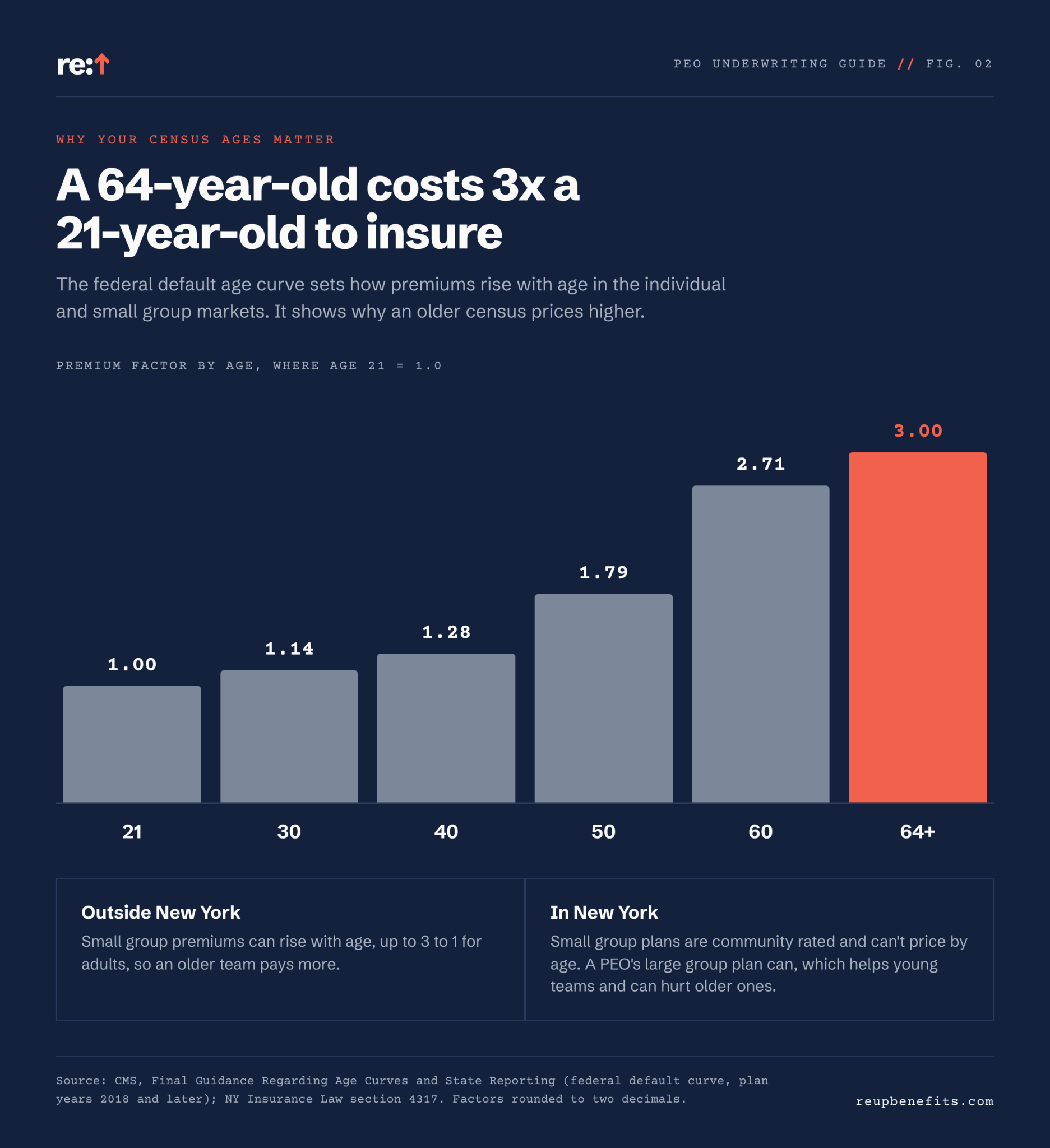
Age is one of the biggest drivers of health insurance cost. The federal default age curve, which sets individual and small group premiums in states without their own curve, prices a 64-year-old at three times a 21-year-old and a 50-year-old at about 1.8 times. In PEO plans, Foothold America notes that groups with much older employees may face higher premiums or an outright decline.
New York's open market works differently. Small group plans here are community rated, so age can't change the price. A PEO's large group plan can price your census by age, which is why a young New York team often does better inside a PEO and an older one often doesn't.
How do PEOs use prescription data?
Some underwriters skip the paper health questionnaire and look at prescription history instead. Data vendors turn prescription claims into a risk score that estimates a group's costs for the coming year. AgencyBloc describes this group Rx (GRx) data as de-identified and aggregated, and Milliman's IntelliScript is one tool that retrieves prescription drug histories for underwriting.
Prescriptions are a strong signal because they show ongoing treatment. A specialty drug for a chronic condition says more about next year's costs than most answers on a form. Smaller groups are more likely to get a medical health questionnaire instead, because there's less data to score.
Can a PEO charge a sick employee more?
No. Federal HIPAA rules bar a group health plan from charging one person more than a similarly situated coworker based on a health factor, such as a medical condition or claims history. The same rules don't limit the total amount an employer can be charged. So health risk can raise your company's rate, or keep you out of a plan, but it can't single out one employee's premium.
How does PEO workers' comp underwriting work?
Workers' comp underwriting asks how likely your people are to get hurt on the job and how expensive those injuries tend to be. It runs on its own rules, because many PEOs cover clients under one master policy, and the carrier behind that policy limits what the PEO can write.
- Class codes and payroll. Every job type has a class code with its own rate per $100 of payroll.
- Experience mod. Your claims compared with similar businesses; above 1.0 costs more. PEOs still use your mod to price you internally, even on a master policy.
- Loss runs. Carrier reports of your past claims, usually for the last two to three years.
- Coverage history. Gaps in coverage, or no prior policy at all, raise flags.
- Operations. What the work actually involves, sometimes checked with a site visit before you're accepted.
Why won't some PEOs write risky businesses?
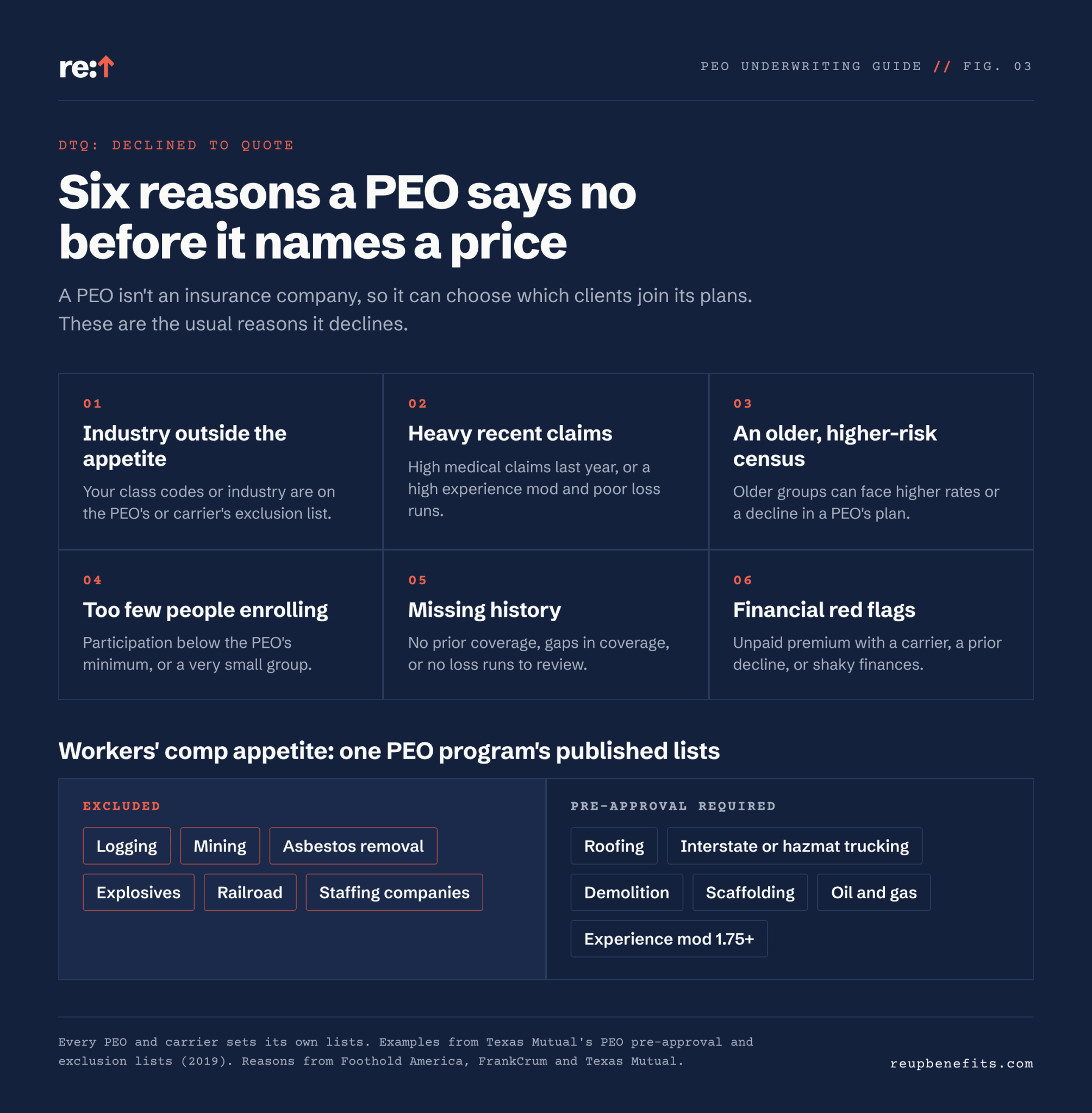
Because their carriers won't let them. A PEO's workers' comp program comes with an appetite: the industries its carrier will cover, review case by case or refuse. Texas Mutual's published PEO pre-approval and exclusion lists, for example, exclude logging, mining, asbestos removal and staffing companies. They require pre-approval for roofing, interstate or hazardous-material trucking, demolition and any client with an experience mod of 1.75 or higher. FrankCrum's PEO underwriting guidelines list flatbed trucking and hot tar work as prohibited.
Appetite varies a lot from one PEO to the next. EORHQ names construction and staffing as the sectors most often declined or priced higher. A roofer can get a decline from one PEO and a quote from another, which is why it pays to shop.
Why would a PEO decline to quote (DTQ)?
A DTQ, short for declined to quote, means the PEO won't offer you coverage at any price. It usually comes down to one of six reasons:
- Industry outside the appetite. Your class codes or industry are on the PEO's or carrier's exclusion list.
- Heavy recent claims. High medical claims in the last year, or a high experience mod and poor loss runs.
- An older, higher-risk census. The group's age or health profile doesn't fit the PEO's pool.
- Too few people enrolling. Participation below the PEO's minimum, or a very small group.
- Missing history. No prior coverage, gaps in coverage, or no loss runs to review.
- Financial red flags. Unpaid premium with a carrier, a prior decline, or shaky finances.
A DTQ from one PEO isn't a verdict on your company. It tells you where that PEO's appetite ends. Ask why, fix what you can, and take the same census to PEOs whose appetite fits.
Why do different PEOs quote you different rates?
Because each PEO prices your census against its own pool, its own carriers and its own appetite. The same company can get very different numbers in the same week.
| Factor | Why it changes your price |
|---|---|
| The PEO's pool | Your rate reflects the claims and ages across the PEO's whole book, not just yours |
| Funding | Fully insured, self-funded and level-funded plans price risk differently |
| Carriers and networks | Each PEO works with different carriers, and network strength varies by ZIP code |
| Internal loads | PEOs add their own load for your class codes and loss history on top of the carrier's rate |
| Admin fee | Fees vary widely by PEO and pricing model |
| Quote status | Some quotes are firm; others are "subject to" final underwriting and can change |
That's why a single quote tells you very little. Send an identical census to several PEOs, and the differences you see come from this table. The funding types and admin fees are covered in more depth in our PEO insurance guide.
How do you get the best result from PEO underwriting?
- Send a complete census. Missing ages, ZIP codes or coverage tiers lead to conditional quotes and delays.
- Include your current renewal. Underwriters want to see your rates and how they've moved.
- Pull your loss runs and mod worksheet early. Underwriters commonly ask for two to three years of loss runs.
- Check your class codes. A miscoded job can cost you money or get you declined.
- Explain large claims that have ended. A claimant who finished treatment or left the plan is a different risk than an open one.
- Start 60 to 90 days before your renewal. That leaves time to fix gaps and compare.
- Ask whether each quote is firm. Get the final rate in writing before you sign.
Or have a PEO broker run it for you: one census, several PEOs, and someone who knows each one's appetite before a decline arrives.
Frequently asked questions about PEO underwriting
What does "subject to underwriting" mean on a PEO quote?
It means the price is an estimate until the underwriter finishes reviewing your census, claims or prescription data. The final rate can come back higher, or the PEO can decline. Ask what could change the number, and get the final rate in writing before you sign.
Can I pass PEO health underwriting and fail workers' comp?
Yes. They're separate reviews. Some PEOs let a client keep its own workers' comp policy while joining the PEO for everything else, which can solve a workers' comp decline without giving up the PEO's health plans. The risk tolerance varies grealty for each PEO on both WC and Health. So one decline from one PEO, may be a win on another.
Is PEO underwriting the same in every state?
No. State rules shape it. Four states require workers' comp from a state fund, and each PEO's carriers set different rules by state. Ask every PEO how it handles the states where you have employees.
If you got a decline, or a quote that came back "subject to," book a 20-minute review with me. Bring the census and the quote, and I'll show you where you stand.
Sources
This article is general information, not legal, tax or insurance advice. Underwriting rules vary by PEO, carrier and state. Figures are as of October 2026.
- 45 CFR 147.104, guaranteed availability of coverage
- 29 CFR 2590.702, HIPAA nondiscrimination rules
- CMS: Final guidance regarding age curves and state reporting
- Foothold America: The truth about PEO master health plans
- AgencyBloc: Agent's guide to GRx for group health insurance
- Milliman: Medical underwriting suite
- Texas Mutual: PEO pre-approval and exclusion lists
- FrankCrum: PEO underwriting guidelines
- EORHQ: Workers' comp through a PEO