
By Cesar Figueroa, Owner, ReUp Benefits
In this guide
How does PEO workers' comp work? When you join a PEO, the PEO usually secures workers' comp coverage for your employees and bills the premium with each payroll, based on actual wages. The insurance carrier pays and manages claims. You still run the worksite, keep your OSHA log and report injuries. When you leave, your own policy has to start the same day.
This post expands the workers' comp section of our guide to what a PEO is in insurance. I spent more than ten years inside three PEOs. Here's how workers' comp actually works once you sign, answered in the order buyers ask.
How does a PEO handle workers' comp compliance?
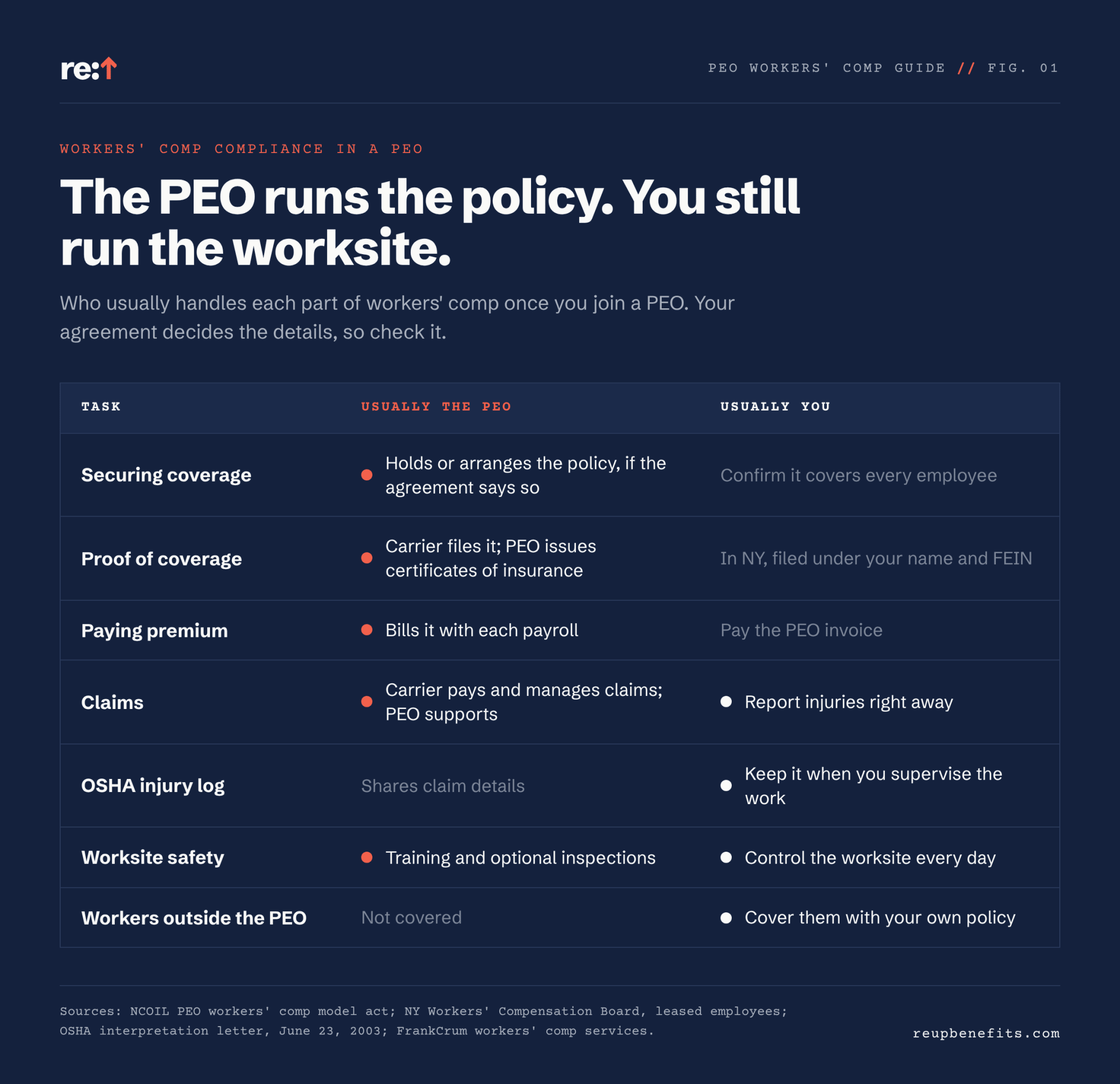
A PEO handles the insurance side of workers' comp, and you keep the workplace side. The NCOIL model act for PEO workers' comp, a template written by state legislators, sets out the basic deal. The PEO agreement has to say whether the PEO or the client secures coverage, and if it's the PEO, the PEO must keep coverage in force for as long as the agreement lasts. Claims are paid and administered by the licensed insurer. And the agreement doesn't relieve you of your responsibility for showing you're in compliance.
| Task | Usually the PEO | Usually you |
|---|---|---|
| Securing coverage | Holds or arranges the policy, if the agreement says so | Confirm it covers every employee |
| Proof of coverage | Carrier files it; PEO issues certificates of insurance | Check it's filed correctly |
| Paying premium | Bills it with each payroll | Pay the PEO invoice |
| Claims | Carrier pays and manages claims; PEO supports | Report injuries right away |
| OSHA injury log | Shares claim details | Keep it when you supervise the work |
| Worksite safety | Training and optional inspections | Control the worksite every day |
Two rules catch people off guard. First, OSHA puts the injury log on the company that directs the work. In a 2003 interpretation, OSHA said that when leased workers are under the client's day-to-day supervision, the recordkeeping responsibility belongs entirely to the client. That's you.
Second, state rules decide how coverage is set up. In New York, the Workers' Compensation Board allows two options: you buy your own policy, or the PEO buys a policy in your name for the leased employees. Either way, proof of coverage is filed under your legal name and FEIN, and anyone you employ outside the PEO needs coverage too. In North Dakota, Ohio, Washington and Wyoming, coverage has to come from the state fund, so a PEO's private policy can't replace it.
Do I pay workers' comp with a PEO?
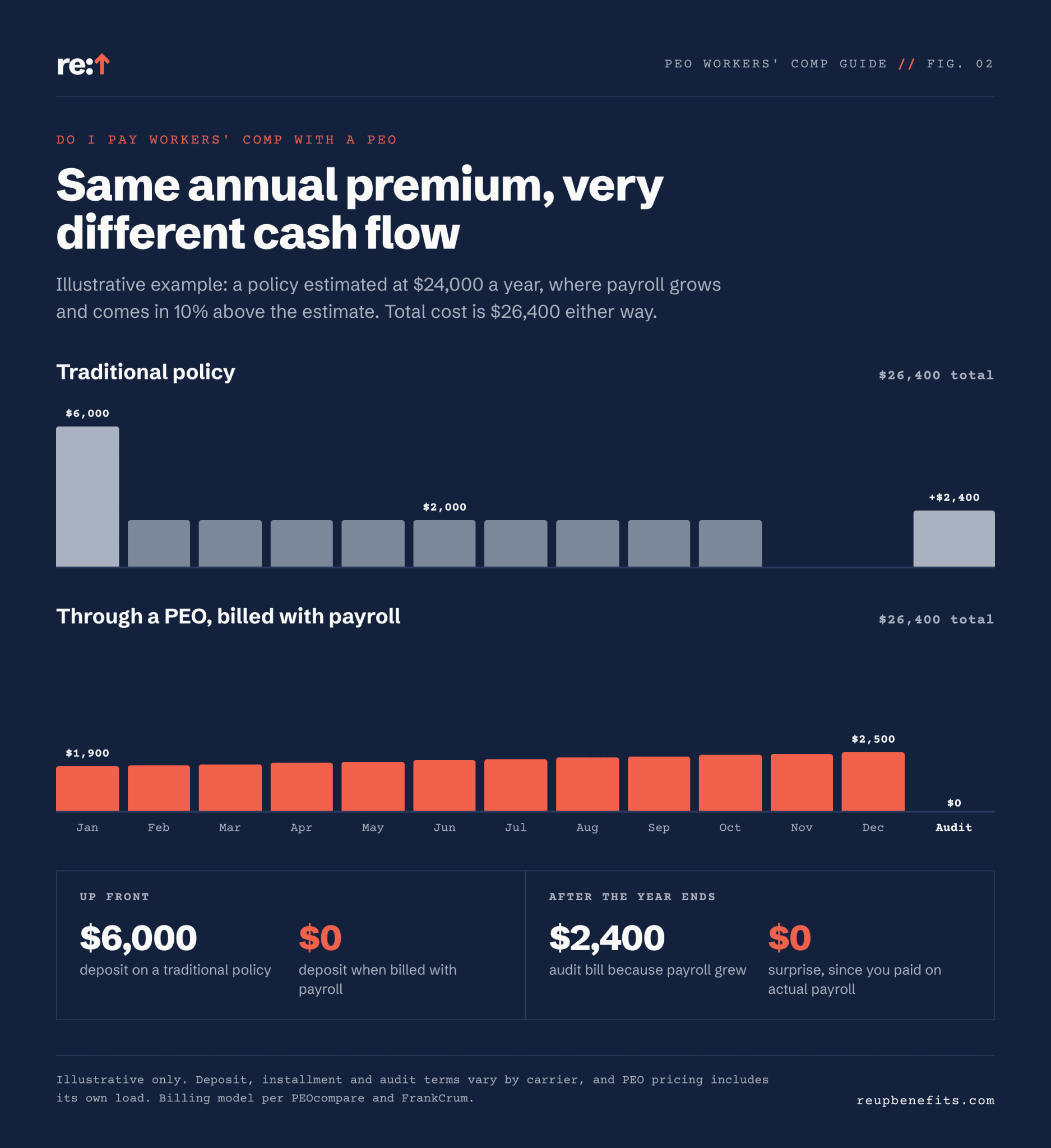
Yes. Workers' comp is part of what you pay the PEO, usually as a line on each payroll invoice. The premium is calculated from your actual payroll for each class code every pay period, so you pay as you go instead of up front.
On a traditional policy, you pay a deposit based on estimated payroll, then settle up after a year-end audit. If you grew, you owe the difference. Through a PEO, premium is billed on actual payroll each period, so there's no large deposit and far fewer audit surprises. For a seasonal business or a fast-growing startup, that cash flow difference is real.
Pay-as-you-go changes when you pay, not necessarily how much. Your rate still depends on your class codes, your claims history and the load the PEO adds to its carrier's cost. Ask to see workers' comp itemized by class code on your rate exhibit. EORHQ recommends the same, because bundled pricing is hard to benchmark.
Do PEOs get better workers' comp rates?
Sometimes, but not automatically. A PEO buys coverage for many clients at once, and EORHQ notes that a PEO's carrier pricing follows pooled experience more than your standalone experience mod. A strong pool and a good carrier program can produce a better rate than you'd get alone.
Your own record still counts, though. Under the NCOIL model, a client's premium is based on its own experience mod when it's large enough to be experience rated. EORHQ says PEOs use your mod for internal pricing even on a master policy, and the PEO adds its own load on top of the carrier's rate. So a PEO can beat your standalone price, and it can also cost more than a company with a clean record would pay on its own policy.
The only way to know is to compare, line by line:
- Get the PEO's rate per $100 of payroll for each of your class codes.
- Get a standalone quote for the same class codes and payroll.
- Compare the experience mod each price assumes.
- Add any workers' comp fees or minimums. FrankCrum's guidelines, for example, list a minimum workers' comp fee for some programs.
Some PEOs won't quote high-risk industries at all. We cover how PEOs underwrite workers' comp, and why roofers and truckers often face extra review or a decline, in PEO underwriting.
How do I get workers' comp out of a PEO?
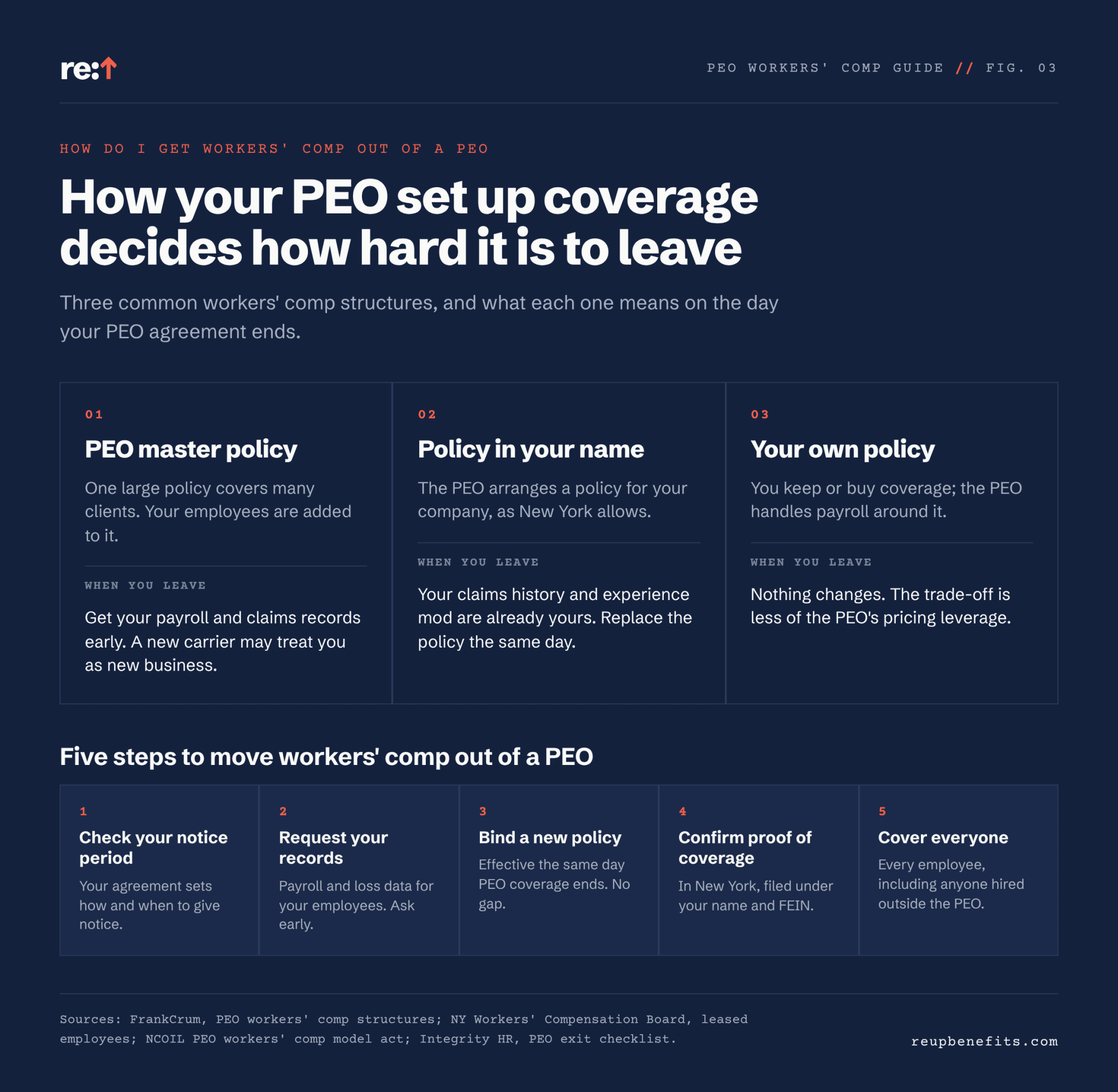
Plan it like any policy change: your new coverage has to start the moment PEO coverage ends, and you need your claims history to buy it. How hard that is depends on how your PEO set up coverage. If your employees sat on a PEO master policy, your claims history may be blended into the PEO's. If the PEO arranged a policy in your name, your history is already yours.
- Check your notice period. Your agreement sets how and when you can leave.
- Request your records early. The NCOIL model calls for the PEO to give you payroll and loss records for your employees within 60 days after the agreement ends. Ask before you give notice, so you can shop with them.
- Bind a new policy effective the same day. Integrity HR warns there can be no lapse, and some carriers may treat you as new business because you haven't held a policy in your own name.
- Confirm proof of coverage. In New York, it must be filed under your name and FEIN.
- Cover everyone. Every employee, including anyone hired outside the PEO.
- Ask about open claims. Find out how claims from your PEO years will be handled after you leave, and who you'll call about them.
Workers' comp is only one line that moves when you leave. Our guide covers everything that moves at once, with a timeline.
Frequently asked questions about PEO workers' comp
Is my company still liable if the PEO's coverage lapses?
You can be. Under the NCOIL model, a PEO agreement doesn't relieve you of showing compliance, and in New York employers are responsible for covering all of their employees. Ask for a certificate of insurance, and confirm your coverage is on file with your state's workers' comp board.
Who handles a claim when an employee gets hurt?
Report it to the PEO right away. The insurance carrier pays and manages the claim, and many PEOs add claims support and return-to-work programs on top. FrankCrum, for example, lists both.
Can I keep my own workers' comp policy and still use a PEO?
Yes, if the PEO allows it. Some PEOs run payroll around a policy you keep or buy yourself. You keep full control and an easy exit, but you give up some of the PEO's pricing leverage.
Comparing a PEO's workers' comp rate against your own policy, or planning a move? Book a 20-minute review with me. Bring your class codes, payroll and loss runs.
Sources
This article is general information, not legal, tax or insurance advice. Workers' comp rules vary by state. Figures are as of October 2026.
- NCOIL: PEO workers' compensation model act
- OSHA: Recordkeeping for temporary and leased employees (2003 interpretation)
- NY Workers' Compensation Board: coverage for leased employees
- FrankCrum: Workers' compensation services
- FrankCrum: PEO underwriting guidelines
- PEOcompare: Workers' comp with a PEO
- EORHQ: Workers' comp through a PEO
- Integrity HR: Moving away from a PEO