
By Cesar Figueroa, Owner, ReUp Benefits
In this guide
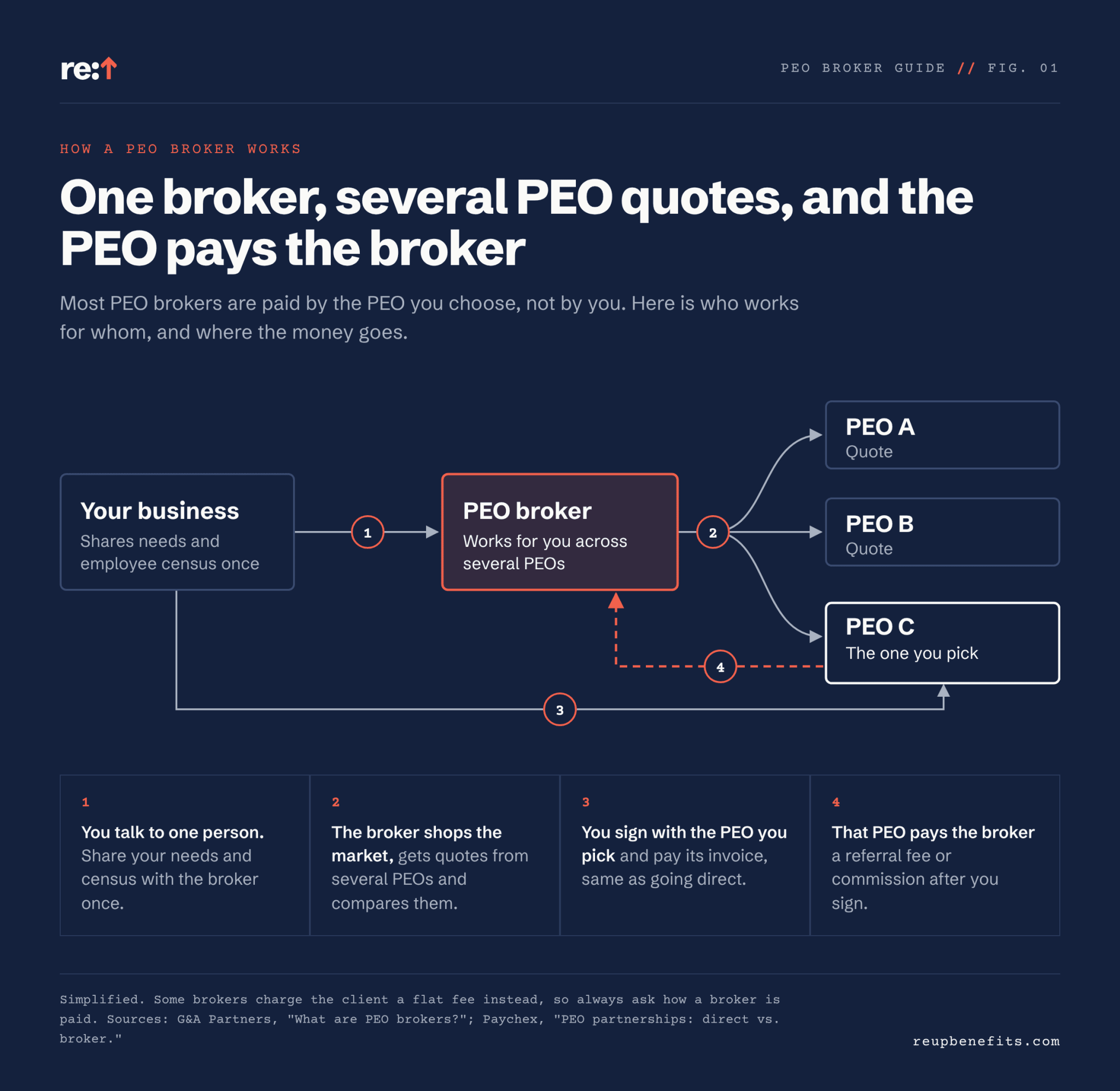
What is a PEO broker? A PEO broker is an independent advisor who helps a business choose a professional employer organization (PEO). Instead of calling PEOs one at a time, you work with one broker who gets quotes from several, lays them side by side, negotiates price and terms, and checks back at every renewal. Most PEO brokers are paid by the PEO you choose.
New to PEOs? Start with our guide to what a PEO is in insurance, which explains how PEO health plans, workers' comp and pricing work. I spent more than ten years inside three PEOs before starting ReUp Benefits, so I know the broker relationship from the PEO side. Now I work it from yours.
What does a PEO broker do?
A PEO broker runs the buying process for you, from the first conversation to every renewal after you sign. A PEO sales rep represents one company. A broker works with several PEOs and represents you.
The work usually follows six steps:
- Learn your business. Headcount, states, current benefits, budget and what isn't working today.
- Build your census. That's the employee list (ages, ZIP codes, coverage tiers) PEOs use to price your health plans.
- Get quotes from several PEOs that fit your size, your industry and the states you hire in.
- Compare them side by side: admin fee, health premiums, workers' comp rates, add-ons and contract terms.
- Negotiate the price and the contract before you sign, then help with the switch.
- Review every renewal to check the increase and re-shop if it doesn't hold up.

That last step is the one most buyers skip. Your first-year price is a sales price. The renewal is the real one.
How do PEO brokers get paid?
PEO brokers are paid by the PEO you choose, not by you. The PEO pays the broker a referral fee or commission after you sign, which is why broker help usually doesn't come with an invoice.
Neither model is wrong, but the PEO-paid model has a catch. As G&A Partners, itself a PEO, points out, broker pay can vary by provider, but it does NOT impact the cost you pay as a customer.
Should you use a PEO broker or go direct?
Going direct makes sense if you already know which PEO you want and you're comfortable negotiating. A PEO broker is worth it when you want to see the market, compare real numbers and have someone else push on price.
| Going direct to a PEO | Using a PEO broker | |
|---|---|---|
| Who represents you | No one; the PEO's sales rep represents the PEO | The broker |
| PEOs you see | One per sales process | Several at once |
| Price comparison | You build it yourself | Side by side, line by line |
| Negotiation | You, against a trained sales team | The broker, who knows typical pricing |
| Cost to you | The PEO's fees | The PEO's fees; most brokers are paid by the PEO |
| At renewal | You review the increase alone | The broker benchmarks it and re-shops if needed |
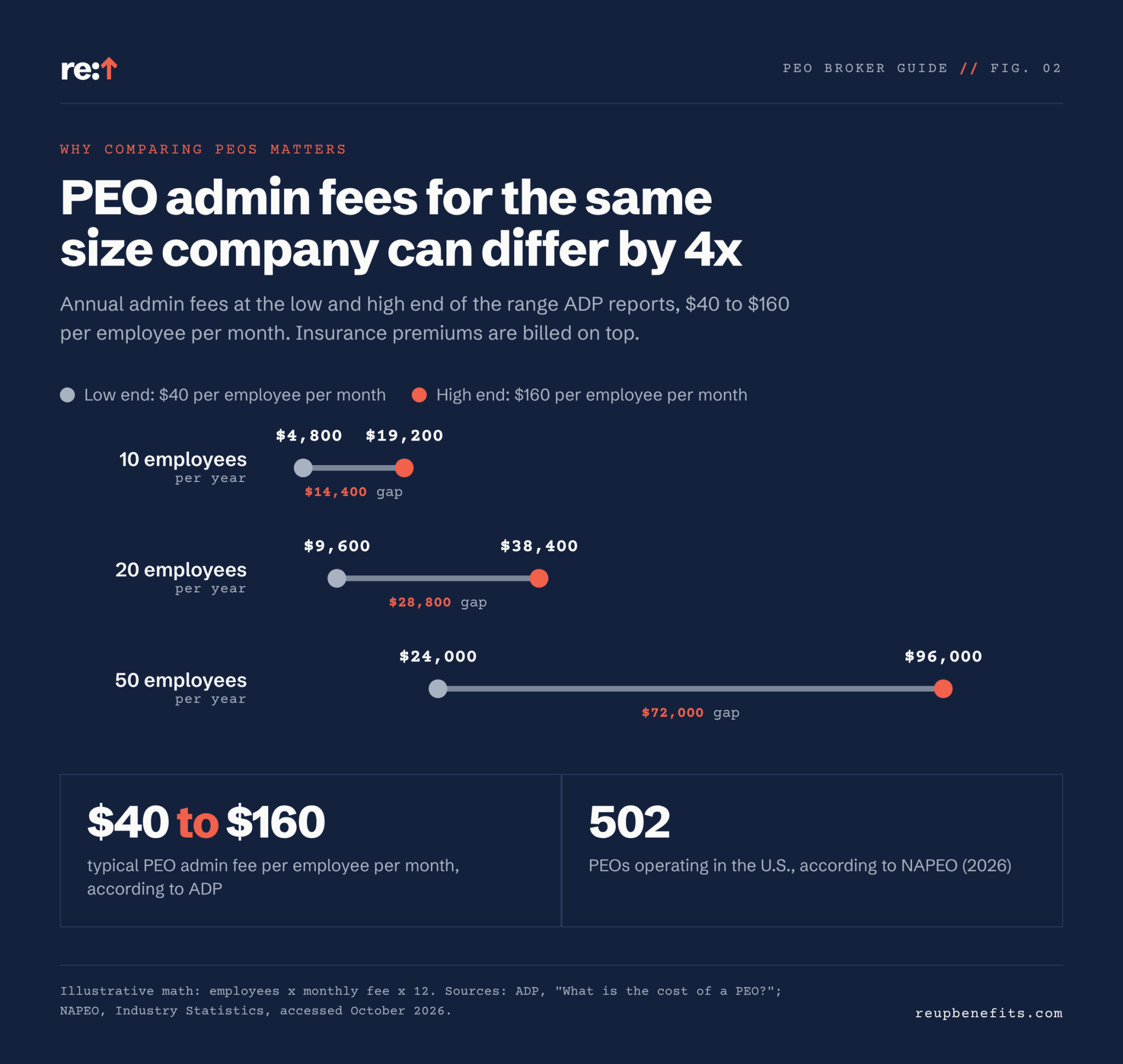
The spread in pricing is why comparing matters. ADP says PEO admin fees run about $40 to $160 per employee per month. For a 20-person company, that's $9,600 to $38,400 a year before a single insurance premium. NAPEO counts 502 PEOs in the U.S. (2026), so nobody quotes all of them, but seeing three or four changes the conversation.
PEO broker near me or online: does location matter?
Less than it used to. Most PEO broker work happens over email, phone and video, so a PEO broker online can serve you from anywhere. What matters is whether the broker knows your state.
State rules change the math. In New York, small group health plans are community rated and employers must carry disability and paid family leave coverage, and both shift whether a PEO's plan beats the open market. Our PEO insurance guide covers both. So when you search for a PEO broker near me, look past the map pin. Ask which states they work in and for references from companies like yours.
One warning about searching online. Some "compare PEOs" forms are lead-generation sites that pass your details to several PEO sales teams. That isn't a broker. Nobody on that path works for you, and the sales calls start right away.
How do you choose a PEO broker?
Pick the broker who answers these five questions clearly, and in writing:
- How are you paid, and does it change depending on which PEO I pick?
- Which PEOs do you work with, and how many will you quote for me?
- Can I see a sample side-by-side comparison?
- Have you worked with companies my size, in my industry and my states?
- What do you do after I sign, and at renewal?
Watch for red flags: a broker who won't explain their pay, pushes one PEO before you've seen itemized quotes, or rushes you to sign. Even Paychex, which sells PEO services, tells buyers to watch for the same things.
Frequently asked questions about PEO brokers
Do I have to pay a PEO broker?
Usually not. Most PEO brokers are paid a referral fee or commission by the PEO you sign with. Some charge the client a flat fee instead. Either way, ask before you share any company data, and get the answer in writing.
Is a PEO broker the same as an insurance broker?
No. A benefits or insurance broker helps your company buy a health plan it sponsors itself. A PEO broker helps you choose a PEO, which sponsors the plans for you through co-employment. Some advisors do both, so ask which role they're playing.
Can a PEO broker help if I already use a PEO?
Yes, and renewal is the best time. A broker can benchmark what you pay now, get competing quotes and use them to negotiate. Sometimes the best result is staying with your current PEO at a better price.
If you're comparing PEOs or looking at a renewal notice, book a 20-minute review with me. Bring your current invoice and I'll show you what to ask for.
Sources
This article is general information, not legal, tax or insurance advice. Figures are as of October 2026.
- NAPEO: Industry statistics
- ADP: What is the cost of a PEO?
- G&A Partners: What are PEO brokers?
- Paychex: PEO partnerships, direct vs. broker
- TriNet: Why should you use a PEO broker?