
By Cesar Figueroa, Licensed Health Insurance & PEO Broker, ReUp Benefits
In this guide
How do PEO SUI rates work? It depends on the state. In PEO reporting states, the PEO pays state unemployment tax under its own account and bills you at its rate or a contract rate. In client reporting states, you keep your own account and rate. In 2026, maximum state rates run from 5.4% to over 17%.
State unemployment insurance is one of the least understood lines on a PEO invoice. It looks like a tax, so most clients never question it, but the rate you pay can depend more on your PEO and your state than on your own claims history. I spent more than ten years inside three PEOs, and SUI is one of the places I see the biggest gaps between quotes. This guide explains how SUI works, how PEO SUI rates are set, which states use PEO or client reporting, and the 2026 rate caps for every state. For the bigger pricing picture, see our PEO pricing guide.
How does state unemployment insurance (SUI) work?
SUI is a state payroll tax that funds unemployment benefits. Each employer pays a percentage rate on each employee's wages up to a yearly cap called the taxable wage base. Once an employee earns past the wage base, no more SUI is due on them that year.
Your rate depends on your history. New employers start at a set new employer rate. After a few years, the state assigns an experience rate based on how many former employees have collected benefits against your account. Fewer claims mean a lower rate, and frequent layoffs push it toward the state's maximum.
New York shows how this works. Its 2026 wage base is $17,600, and the state's 2026 rates run from 1.7% to 9.5%, with new employers at 4.1%. A new employer pays about $722 per employee a year. An employer at the maximum pays about $1,672.
How do PEO SUI rates work?
When you join a PEO, the state decides whose unemployment account your payroll is reported under, and that decides whose rate you pay. In most states, the rules decide this, not the PEO or you.
In a PEO reporting state, the PEO is the employer of record for SUI. It files under its own account at a rate based on the claims of all its clients, and you lose your own rate there. Justworks puts it plainly for Texas: "your company's SUI rate no longer applies in Texas." What you are billed is set by your contract, which may or may not match what the PEO pays the state. Our guide to how a PEO makes money explains why this line can carry margin.
In a client reporting state, SUI is still paid through the PEO, but it is filed under your company's own account and rate. Your claims history stays yours.
What is the difference between PEO and client reporting states?
The difference is whose account and rate are used. PEO reporting states use the PEO's account. Client reporting states use yours. A third group, hybrid states, uses a separate client account linked to the PEO's master account.
| PEO reporting | Client reporting | Hybrid | |
|---|---|---|---|
| Whose account | The PEO's | Your company's, tied to your EIN | Yours, linked to the PEO's master account |
| Whose rate | The PEO's pooled rate or a contract rate | Your own experience rate | Depends on the state's rules |
| Your claims history | Stops building in your own account | Stays yours | Tracked in your linked account |
| Where markup can hide | The billed rate vs what the PEO pays | Less room, since your rate is set by the state | Ask the PEO |
In my experience, the biggest surprise for clients is in PEO reporting states. A company with a clean history and a low rate can end up paying the PEO's higher rate, and that cost shows up as a tax, not a fee.
Which states are client reporting vs PEO reporting?
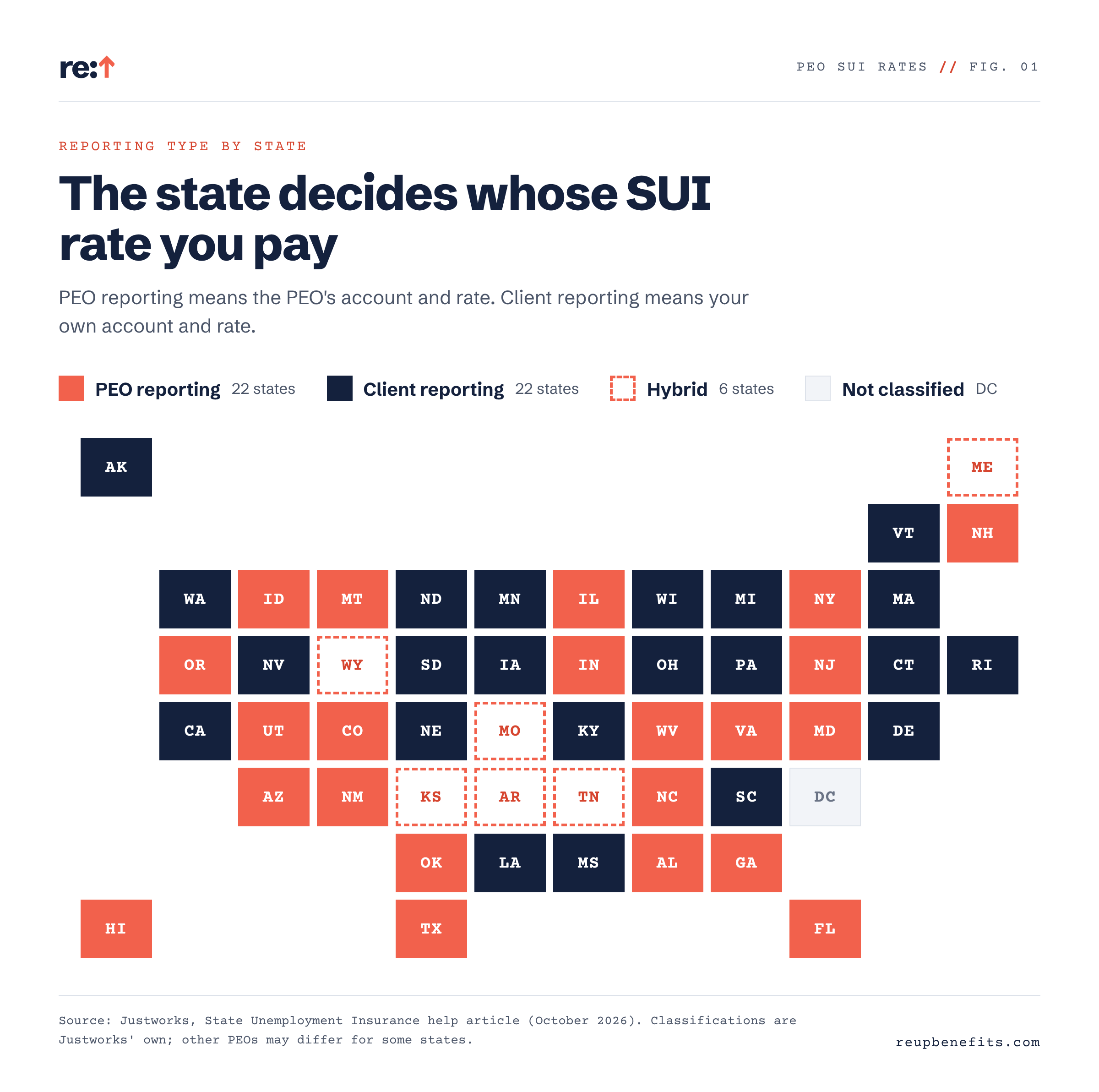
Justworks splits the 50 states into 22 PEO reporting, 22 client reporting and 6 hybrid states. Treat this as one PEO's classification. Some states let PEOs choose or set conditions, so other PEOs may classify a few states differently. StaffMarket's SUTA directory, for example, lists California and Washington as PEO reporting.
PEO reporting states: Alabama, Arizona, Colorado, Florida*, Georgia*, Hawaii, Idaho, Illinois*, Indiana, Maryland, Montana, New Hampshire, New Jersey, New Mexico, New York, North Carolina, Oklahoma*, Oregon, Texas, Utah, Virginia, West Virginia.
Client reporting states: Alaska, California, Connecticut, Delaware, Iowa, Kentucky, Louisiana, Massachusetts, Michigan, Minnesota, Mississippi, Nebraska, Nevada, North Dakota, Ohio, Pennsylvania, Rhode Island, South Carolina, South Dakota, Vermont, Washington, Wisconsin.
Hybrid states: Arkansas, Kansas, Maine, Missouri, Tennessee, Wyoming.
* Justworks notes that some situations in Florida, Georgia, Illinois and Oklahoma require client-level reporting.
2026 SUI rate caps by state
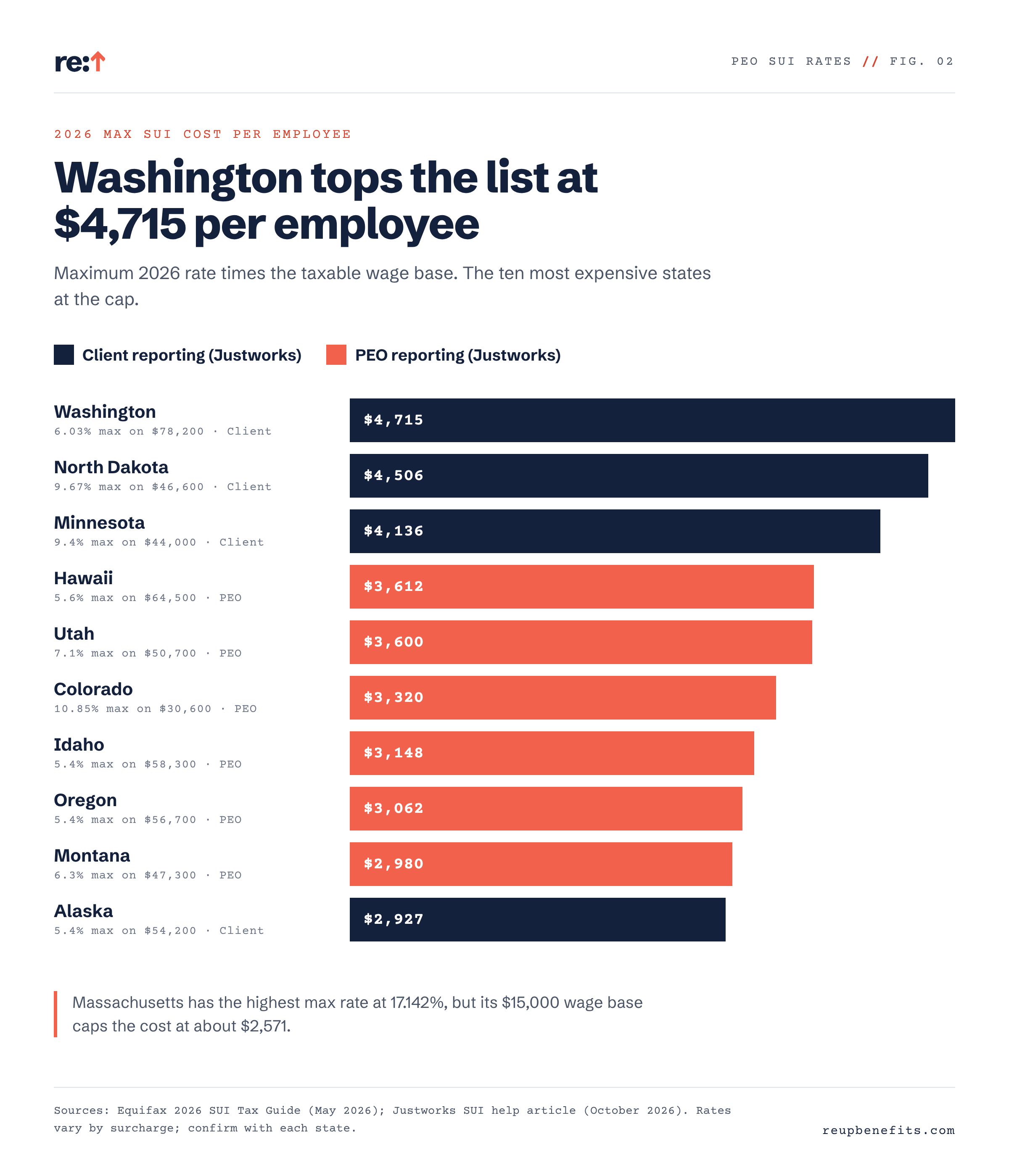
Every state caps the SUI rate an employer can be charged. The table shows each state's 2026 minimum rate, maximum rate and taxable wage base from Equifax's 2026 SUI Tax Guide (updated May 2026), plus the most SUI you could owe per employee in a year, which is the maximum rate times the wage base.
| State | Reporting (Justworks) | 2026 min rate | 2026 max rate | 2026 wage base | Max SUI per employee |
|---|---|---|---|---|---|
| Alabama | PEO | 0.2% | 5.4% | $8,000 | $432 |
| Alaska | Client | 1% | 5.4% | $54,200 | $2,927 |
| Arizona | PEO | 0.03% | 8.36% | $8,000 | $669 |
| Arkansas | Hybrid | 0.2% | 10.1% | $7,000 | $707 |
| California | Client | 1.6% | 6.2% | $7,000 | $434 |
| Colorado | PEO | 0.72% | 10.85% | $30,600 | $3,320 |
| Connecticut | Client | 1.1% | 9.9% | $27,000 | $2,673 |
| Delaware | Client | 0.6% | 5.6% | $14,500 | $812 |
| District of Columbia | Not listed | 2.1% | 7.6% | $9,000 | $684 |
| Florida | PEO * | 0.1% | 5.4% | $7,000 | $378 |
| Georgia | PEO * | 0.04% | 8.1% | $9,500 | $770 |
| Hawaii | PEO | 0% | 5.6% | $64,500 | $3,612 |
| Idaho | PEO | 0.208% | 5.4% | $58,300 | $3,148 |
| Illinois | PEO * | 0.75% | 7.05% | $14,250 | $1,005 |
| Indiana | PEO | 0.5% | 7.4% | $9,500 | $703 |
| Iowa | Client | 0% | 5.4% | $20,400 | $1,102 |
| Kansas | Hybrid | 0% | 6.95% | $15,100 | $1,049 |
| Kentucky | Client | 0.3% | 9% | $12,000 | $1,080 |
| Louisiana | Client | 0.09% | 6.2% | $7,000 | $434 |
| Maine | Hybrid | 0.31% | 6.6% | $12,000 | $792 |
| Maryland | PEO | 0.3% | 7.5% | $8,500 | $638 |
| Massachusetts | Client | 1.174% | 17.142% | $15,000 | $2,571 |
| Michigan | Client | 0.06% | 12.2% | $9,000 | $1,098 |
| Minnesota | Client | 0.5% | 9.4% | $44,000 | $4,136 |
| Mississippi | Client | 0.2% | 5.6% | $14,000 | $784 |
| Missouri | Hybrid | 0% | 6.75% | $9,000 | $608 |
| Montana | PEO | 0.13% | 6.3% | $47,300 | $2,980 |
| Nebraska | Client | 0% | 5.4% | $9,000 | $486 |
| Nevada | Client | 0.3% | 5.4% | $43,700 | $2,360 |
| New Hampshire | PEO | 0.1% | 7.5% | $14,000 | $1,050 |
| New Jersey | PEO | 0.5% | 5.8% | $44,800 | $2,598 |
| New Mexico | PEO | 0.33% | 6.4% | $34,800 | $2,227 |
| New York | PEO | 1.7% | 9.5% | $17,600 | $1,672 |
| North Carolina | PEO | 0.06% | 5.76% | $34,200 | $1,970 |
| North Dakota | Client | 0.07% | 9.67% | $46,600 | $4,506 |
| Ohio | Client | 0.55% | 10.25% | $9,000 | $922 |
| Oklahoma | PEO * | 0.2% | 5.8% | $25,000 | $1,450 |
| Oregon | PEO | 0.9% | 5.4% | $56,700 | $3,062 |
| Pennsylvania | Client | 1.142% | 10.373% | $10,000 | $1,037 |
| Rhode Island | Client | 0.9% | 9.4% | $30,800 | $2,895 |
| South Carolina | Client | 0.06% | 5.46% | $14,000 | $764 |
| South Dakota | Client | 0.08% | 9.13% | $15,000 | $1,370 |
| Tennessee | Hybrid | 0.01% | 10% | $7,000 | $700 |
| Texas | PEO | 0.32% | 6.32% | $9,000 | $569 |
| Utah | PEO | 0.1% | 7.1% | $50,700 | $3,600 |
| Vermont | Client | 0.4% | 5.4% | $15,400 | $832 |
| Virginia | PEO | 0.1% | 6.2% | $8,000 | $496 |
| Washington | Client | 0.27% | 6.03% | $78,200 | $4,715 |
| West Virginia | PEO | 1.5% | 8.5% | $9,500 | $808 |
| Wisconsin | Client | 0% | 12% | $14,000 | $1,680 |
| Wyoming | Hybrid | 0.1% | 8.6% | $33,800 | $2,907 |
The rate alone doesn't tell you the cost. Massachusetts has the highest maximum rate at 17.142%, but it applies to a $15,000 wage base, for a top cost of about $2,571. Washington's maximum rate is only 6.03%, but its $78,200 wage base makes it the most expensive state per employee at about $4,715. North Dakota and Minnesota follow at about $4,506 and $4,136.
Rates include different surcharges by state, and Tennessee, Vermont, New Hampshire and New Jersey run fiscal-year rates that start July 1. Confirm current figures with each state agency.
When do PEO SUI rates help or hurt?
PEO SUI rates help you when the PEO's pooled rate is lower than yours and hurt you when it is higher. That's why the same PEO can be a good deal for one company and a bad one for another.
It tends to help if you are a new company stuck at a high new employer rate, or if past layoffs pushed your rate up. A PEO with a large, stable client base may carry a lower rate than you could get alone.
It tends to hurt if your company has years of low turnover and a rate near the state minimum. In a PEO reporting state, you give up that rate and help cover clients with more claims. If the PEO also bills above what it pays, the gap grows. In New York, every point of markup costs $176 per employee a year on the $17,600 wage base.
Two more things affect the math. If you join a PEO mid-year and it is not an IRS-certified PEO, payroll tax wage bases can restart, so some SUI gets paid twice that year. Our guide to what a PEO is in insurance explains how certification avoids this. And when you leave a PEO in a PEO reporting state, ask what rate you will restart at, since you may be treated as a new employer.
How to compare PEO SUI rates
To compare PEO SUI rates, ask every PEO the same questions, in writing, for each state where you have employees. Is this a PEO reporting, client reporting or hybrid state for you? What SUI rate will you bill me, and on what wage base? Is that the rate you pay the state, or does it include a markup or fee? What happens to my rate and history if I leave?
Then compare the answers to your own current rate notices. If a PEO's billed rate is well above yours in a PEO reporting state, that is a real cost to negotiate. Our guides to PEO discounts, PEO cost savings and average PEO fees cover the other levers.
As a licensed health insurance and PEO broker, I line up SUI, workers' comp and health rates side by side across PEOs, not just the admin fee. Book a 20-minute call with me. Bring your current PEO invoice or proposal and your latest state unemployment rate notices, and I'll show you what SUI is really costing you.
Frequently asked questions about PEO SUI rates
What is a PEO SUI rate?
It is the state unemployment insurance rate applied to your employees' wages while you are on a PEO. In PEO reporting states, it is usually the PEO's pooled rate or a contract rate. In client reporting states, it is your own company's rate.
What is a client reporting state?
A state that requires SUI to be filed under an unemployment account tied to the client company's own EIN, even when a PEO runs payroll. Your company keeps its own rate and claims history. Massachusetts, California and Pennsylvania are client reporting states for Justworks.
What is a PEO reporting state?
A state where the PEO reports and pays SUI under its own unemployment account. Your company's own rate stops applying there, and you are billed at the PEO's rate or a contract rate. New York, Texas and Florida are PEO reporting states for Justworks.
What is the highest SUI rate in 2026?
Massachusetts has the highest maximum rate on Equifax's 2026 list at 17.142%, applied to a $15,000 wage base. In dollars per employee, Washington is highest at about $4,715, because its 6.03% maximum rate applies to a $78,200 wage base.
Can a PEO charge more than the SUI rate it pays?
In PEO reporting states, what you are billed is set by your contract, not by the state, so it can differ from what the PEO pays. Ask each PEO in writing which rate it will bill you in each state and whether it includes any markup.
Sources
This guide is general information, not legal, tax or insurance advice. State reporting rules vary by PEO and change over time, and rates include different surcharges by state. Confirm details with your PEO and the state agency. Figures are as of October 2026 unless noted.
- Justworks: State Unemployment Insurance (SUI), reporting states (accessed October 2026)
- Justworks: Texas State Unemployment Insurance (accessed October 2026)
- Equifax: 2026 SUI Tax Guide (updated May 27, 2026)
- NYS Department of Labor: 2026 unemployment insurance rates
- StaffMarket: SUTA by state directory (2026)
- Eddy: 2026 new employer rates and SUI wage base limits (December 2025)