By Cesar Figueroa, Owner, ReUp Benefits · Licensed health insurance and PEO broker · Updated October 24, 2026
In this guide
What are the group health insurance options for a small business? Small businesses can choose fully insured, level-funded or self-insured plans, a MEWA or association plan, open-market small group coverage that varies by state, an ICHRA, or a PEO master policy. The right fit depends on your headcount, claims history, location and how much financial risk you can carry.
Picking group health insurance is confusing because the same word covers very different products. I spent more than ten years inside three PEOs, and the most common mistake I saw was owners comparing premiums without understanding the structure behind them. This guide walks through the basics of health insurance, then each funding option, how each one is underwritten, what drives cost, and how to shop. If you want the PEO side in depth, see our guide to what a PEO is.
What are the group health insurance options for a small business?
There are six common structures. They differ mainly in one thing: who pays when employees file big claims. They also differ in how they are underwritten, which means how the price is set and who can say no. The table shows the short version, and each option gets its own section below.
| Option | Who carries claims risk | Usually fits |
|---|---|---|
| Fully insured | The insurance carrier | Teams that want predictable, simple coverage |
| Level-funded | You, up to a stop-loss cap | Healthy groups that can handle some claims variance |
| Self-insured | You, with stop-loss insurance | Larger groups with cash reserves and stable claims |
| MEWA or association plan | Depends: the carrier or the pool | Groups that qualify through a real association |
| ICHRA | Individual market carriers | Mixed-location or mixed-age teams on a fixed budget |
| PEO master policy | The carrier, pooled under the PEO | Small teams that also want payroll and HR outsourced |

Open-market small group coverage, the standard fully insured plan you can buy on or off the exchange, is not a separate structure. It is the fully insured option, and its rules change by state. I cover that in its own section because it trips up so many owners.
If you only need the decision help, jump to how to choose. If health insurance vocabulary still feels fuzzy, start with the basics in the next section. Everything after that builds on it.
Health insurance basics: premium, deductible, copay and coinsurance
Five terms explain most of what you and your employees will pay: premium, deductible, copay, coinsurance and out-of-pocket maximum. The rest of this guide assumes you know them.
| Term | Plain meaning | Who pays it |
|---|---|---|
| Premium | The monthly price of the plan. In a group plan, the employer pays part and the employee pays the rest through payroll. | Employer and employee |
| Deductible | The amount of covered care the employee pays first each plan year before the plan starts sharing costs. | Employee |
| Copay | A flat fee for a service, such as a doctor visit or prescription, often paid at the time of care. | Employee |
| Coinsurance | The employee’s percentage of a covered cost after the deductible, such as 20%. | Employee |
| Out-of-pocket maximum | The most an employee can pay in a plan year for covered in-network care. After that, the plan pays 100% of covered in-network costs. | Employee, up to the cap |
| Network | The doctors and hospitals that have agreed to the plan’s prices. Going outside the network usually costs more. | Both, through plan design |

Why the deductible matters as much as the premium
A lower premium often comes with a higher deductible, so the cheapest plan on paper can be the most expensive plan for an employee who gets sick. For context, KFF’s 2025 survey found an average general annual deductible of $1,886 for single coverage among covered workers who have one. At firms with 10 to 199 workers, the average was $2,631.
Plan types: HMO, PPO, EPO, POS and HDHP
The plan type controls how employees reach care. An HMO generally requires a primary care doctor and referrals and stays in network. A PPO allows more freedom to see out-of-network providers at a higher cost. EPO and POS plans sit between the two. KFF reports that 46% of covered workers are in a PPO, 33% in a high-deductible plan with a savings option, and 12% in an HMO.
Metal tiers: bronze, silver, gold and platinum
Fully insured small group plans are sorted into metal tiers by actuarial value, which is the share of average medical costs a plan is expected to pay. Roughly, bronze pays about 60%, silver about 70%, gold about 80% and platinum about 90%. The employee pays the rest through deductibles, copays and coinsurance. According to HealthInsurance.org, small group plans must fall into one of the four levels. Higher tiers cost more in premium and less at the point of care.
Out-of-pocket limits and HSA-eligible plans
Federal rules cap the annual out-of-pocket maximum. For 2026, CMS revised the limits to $10,600 for self-only coverage and $21,200 for family coverage (WTW, July 2025). High-deductible health plans that work with a health savings account have separate IRS limits. For 2026, a qualifying plan needs a deductible of at least $1,700 for self-only and $3,400 for family coverage, with out-of-pocket maximums of no more than $8,500 and $17,000, and the HSA contribution limits are $4,400 and $8,750 (Mercer, June 2025). A 2025 law also made bronze and catastrophic marketplace plans HSA-eligible starting in 2026 (Becker’s Payer).
How does group health insurance work for an employer?
In a group plan, the employer sponsors one plan, chooses how much of the premium to pay, and offers coverage to eligible employees. The carrier, plan administrator or PEO then handles enrollment, claims and renewals. Employees pay their share through payroll deductions.
Contribution and participation rules
Carriers set rules that you need to meet to buy a group plan. The two that matter most are the employer contribution, which is the share of premium you pay, and participation, which is the share of eligible employees who enroll. Word and Brown reports that in some states carriers may decline to issue group coverage if fewer than 50% to 70% of eligible employees enroll. It also notes that federal small group rules let employers enroll between November 15 and December 15 each year, with participation and contribution requirements that may be waived, while other underwriting requirements still apply. In my experience, the contribution rule is the one owners overlook, so ask for it in writing before you apply.
Eligibility and waiting periods
You decide who is eligible, usually full-time employees working a set number of hours. You can also add a waiting period before coverage starts, but federal rules say a group health plan must not apply a waiting period that exceeds 90 days (45 CFR 147.116).
Rules that depend on your size
Three federal rules kick in at different headcounts. The ACA employer mandate applies if you averaged at least 50 full-time employees, including full-time equivalents, in the prior year (IRS). COBRA continuation coverage applies to employers with at least 20 employees (DOL). Below 20 employees, many states have their own continuation laws, so check yours. If you are an ALE, a PEO or ICHRA does not change your count.
What is underwriting, and how does it differ by option?
Underwriting is how a carrier or insurer decides whether to cover your group, what to charge and under what terms. It is the most important difference between these options, and the one least explained in sales conversations.
Here is the short comparison. Each option section below explains the details.
| Option | Who underwrites | What they look at | Can your group’s health change the price? |
|---|---|---|---|
| Fully insured small group | The carrier, within state rules | Age, tobacco use, family tier and location, plus participation and contribution rules | No. ACA small group rates cannot use health status |
| Fully insured large group | The carrier | Often your group’s own claims history | Often yes, depending on state and size |
| Level-funded | The stop-loss carrier and the plan program | Census, health information and sometimes claims history | Yes |
| Self-insured | The stop-loss carrier | Claims history, high-cost claimants and plan design | Yes |
| MEWA | Depends: a carrier or the pool | Depends on whether it is fully insured or self-funded, and on look-through rules | Depends |
| ICHRA | No group underwriting. Individual market carriers | Age, tobacco use and location for each person | No |
| PEO master policy | The PEO and its carriers | Census, and sometimes claims or health questionnaires | Possibly. Large group plans can be experience rated |
The pattern is simple. The more claims risk you take on, the more your group's own health matters to the price. Fully insured small group and the individual market sit at the other end, where the ACA limits what can affect your rate. See CMS market rating reforms for the rules.
What is fully insured group health insurance?
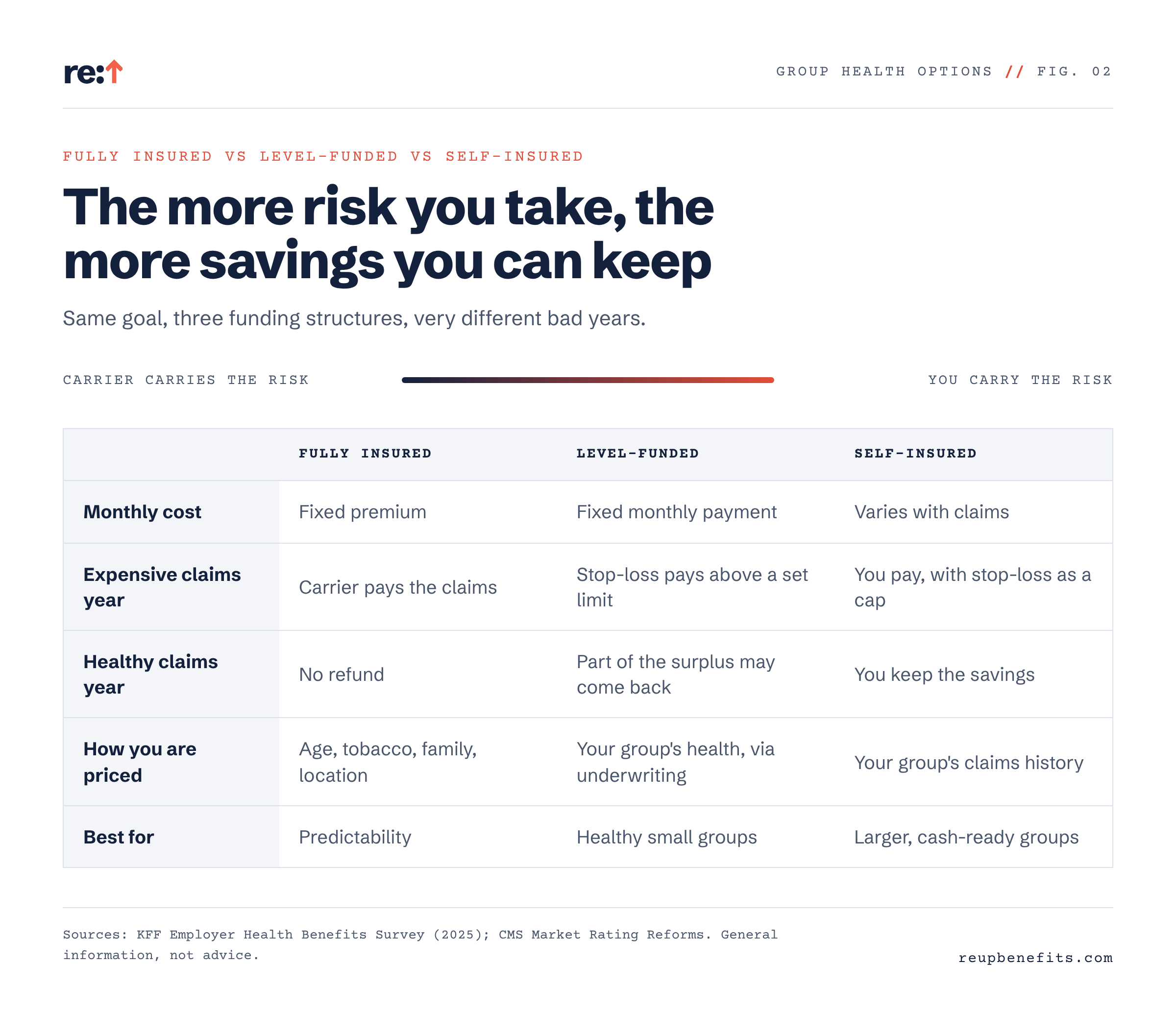
Fully insured means you pay the carrier a fixed premium and the carrier pays the claims. If your employees have a bad year, the carrier absorbs it. This is the most common structure for small employers and the easiest to understand.
How fully insured plans are underwritten
In small group, the ACA limits what a carrier can use to set your rate to age, tobacco use, family size and geography. Carriers cannot charge more because your group is sicker (CMS). They still apply participation and contribution rules, and they price in expected claims for the plan design you choose. Large group plans are different. In my experience, larger fully insured groups are often priced on their own claims history, which is why a good year can lower your renewal and a bad year can raise it.
Medical loss ratio rebates
Under the ACA, a fully insured small group carrier must spend at least 80% of premium dollars on medical care and quality improvement, and 85% for large groups. If a carrier falls short, it must return the difference, and small group rebates go to employers (CMS). This is the one case where a fully insured employer can get money back.
Pros, cons and who it fits
The advantages are predictability, simple administration and a carrier carrying the claims risk. The disadvantages are that you do not share in savings and that state mandates and carrier margins shape the price. Fully insured fits teams that want fixed costs and fewer moving parts, which is most small employers.
How does open-market small group coverage vary by state?
Open-market small group is the standard fully insured coverage sold on and off the exchange, and the rules change by state. Federally, a small group is 1 to 50 employees, though states may extend that to 100. Under the ACA, small group premiums can vary only by age, tobacco use, family size and geography, with age limited to 3 to 1 and tobacco to 1.5 to 1. Some states, including New York and Vermont, use pure community rating and do not allow age or tobacco to affect premiums. See CMS market rating reforms and the KFF state comparison.
Here is what changes from state to state in practice:
- Who counts as small group. Some states use 1 to 100 employees, which changes whether you are rated as small or large group.
- How rates are built. Community rating states give everyone on a plan the same price. Other states allow age and tobacco bands.
- Which carriers and plans exist. The carriers, networks and plan designs you can buy differ by county, not just by state.
- Participation and contribution rules. Carriers set their own minimums within state law.
- Renewal practices. Notice periods and rate review rules vary.
This is why the same 15 person company can see very different options in New York, Texas and Florida. A local advisor who knows your state's carriers saves real time here. For how New York's community rating affects a PEO comparison, see our PEO guide.
What is level-funded health insurance?
Level-funded is a self-funded plan packaged to feel like a fully insured one. You pay a fixed monthly amount that covers expected claims, administration and stop-loss insurance. If claims come in lower than expected, many plans refund part of the surplus. If they run high, stop-loss insurance covers claims above a set limit. KFF describes these arrangements as combining "a relatively small self-funded component with stop-loss insurance" (KFF, 2025).
How level-funded plans are underwritten
This is where level-funded differs most from fully insured. Because the plan is self-funded, it is not bound by ACA small group rating rules, and carriers look at the health of your group to set the price. In my experience, that usually means a census with ages and coverage tiers, a health questionnaire or claims history, and an underwriting decision that can come back with a higher price, a higher limit on certain individuals, or a decline. A group with a few high-cost members may be quoted high or turned down.
What the monthly payment includes
The fixed payment generally breaks into three parts: money set aside to pay claims, fees for the administrator that processes them, and the stop-loss premium. The claims fund is where a refund can come from. KFF also notes that these plans are not required to cover all of the ACA essential health benefits, so compare the plan design closely.
Pros, cons and who it fits
The advantages are a predictable payment and a chance at a refund in a healthy year. The disadvantages are health-based underwriting, less standardized benefits, and renewals that can jump if your claims were high. In my experience, level-funded is a strong fit for a young, healthy team and a poor fit for a group with known chronic conditions.
What is self-insured (self-funded) health insurance?
Self-insured means your company pays employee claims directly from its own funds, usually with a third-party administrator to process them and stop-loss insurance as a safety net. You keep the savings when claims are low and carry the risk when they are not.
Self-funded plans fall under federal ERISA rules, which generally preempt state insurance mandates. That is why larger employers like them. KFF found that 67% of covered workers overall, and 27% of covered workers at firms with 10 to 199 employees, were in self-funded plans in 2025. For most businesses under 50 employees, full self-insurance is more volatility than they need.
What stop-loss insurance does
Stop-loss reimburses a self-funded employer for claims above a set level. The American Academy of Actuaries describes its purpose as protecting "an employer's cash flow" (2012 letter to the DOL). It comes in two forms:
- Specific stop-loss covers a single member's claims above an individual limit, which protects against rare but catastrophic claims.
- Aggregate stop-loss covers the group's total claims above a set level, which protects against many smaller claims adding up. The Academy notes small self-funded employers typically buy both.
The same letter put individual limits for smaller groups at roughly $50,000 to $100,000, with the lowest available for groups under 50 employees at about $20,000, and aggregate limits commonly set at 125% of expected claims. It is a 2012 letter, so use those numbers as context, not as a quote. Stop-loss is regulated by states, not ERISA, so rules vary (NAIC model law chart).
How self-funded plans are underwritten
Your plan is not underwritten like a fully insured policy, but your stop-loss is. The stop-loss carrier looks at your claims history, high-cost claimants and plan design, and may set a higher individual limit for a specific person. The administrator also needs data to price its fees. In my experience, a self-funded plan with no claims history is harder to place, which is another reason it suits larger, established groups.
Pros, cons and who it fits
The advantages are control over plan design, no state mandates under ERISA, and keeping the savings. The disadvantages are cash flow swings and the need for reserves and compliance work. The Academy estimated self-funding can save small employers up to about 5%, and many of them see less. It fits larger groups with stable claims and the cash to absorb a bad year.
What is a MEWA or association health plan?
A MEWA (multiple employer welfare arrangement) is a plan that covers employees of more than one employer, such as an association or a professional group. The Department of Labor guide to MEWAs explains that states hold broad power over self-funded MEWAs but limited power over fully insured ones.
How MEWAs are underwritten
It depends on the type. A fully insured MEWA buys a policy from a carrier, so a carrier underwrites it under state rules. Under the federal look-through rule, whether you are treated as small group or large group generally depends on each member employer, not the association as a whole. A self-funded MEWA is underwritten by the pool itself, so its terms depend on how the association sets rates and who it admits.
What to watch for
Two points matter for a small employer. First, a MEWA can be fully insured or self-funded, and those two behave very differently. A self-funded MEWA puts you in a pool with other employers you may know nothing about. Second, a MEWA must meet federal reporting rules, so ask for the plan's Form M-1 filing.
The Department of Labor also rescinded its 2018 association health plan rule in 2024, so the broader association plans that rule allowed are no longer available. Ask any MEWA vendor for its stop-loss and reserve details. See the DOL fact sheet on MEWAs and the ACA.
Pros, cons and who it fits
The advantage is access to a group plan through an association you already belong to. The disadvantages are complexity, uneven state treatment and financial risk if the pool is self-funded. It fits groups that qualify through a real association and have an advisor who has reviewed the filings.
How does an ICHRA work?
An ICHRA (individual coverage health reimbursement arrangement) lets you reimburse employees tax-free for health plans they buy on the individual market. You set a monthly allowance, and each employee picks their own plan.
The main ICHRA rules
Under the federal rules, summarized by HUB International, an ICHRA must be offered on the same terms to everyone within an employee class. You can set different allowances by class, such as full-time versus part-time, salaried versus hourly, or by insurance rating area. Within a class, the allowance can rise with age, but by no more than three times. Employees must be enrolled in individual market coverage to be reimbursed, they must get a notice at least 90 days before the plan year, and they must be able to opt out. Minimum class sizes can apply when you split employees into certain classes. There is no cap on employer size or allowance amount.
Employers with 50 or more full-time equivalent employees must offer coverage that meets the ACA affordability test, which for 2026 uses a 9.96% threshold (HUB International, August 2025). A proposal to rename ICHRAs and add a small employer credit did not make it into the final 2025 law (Becker’s Payer), so the existing rules still apply.
How ICHRA coverage is underwritten
It is not. There is no group policy, so there is no group underwriting. Each employee buys on the individual market, where plans can vary a price only by age, tobacco use and location, not health status (CMS). In my experience, that also means no carrier participation or contribution minimums, which helps teams that struggle to meet them.
Pros, cons and who it fits
ICHRA works well when your employees live in different states, when ages vary widely, or when you want a fixed budget with no renewal surprises. It works less well if you want everyone on one plan with one carrier. Employees also need to shop, which takes some hand holding.
How does a PEO master policy work?
A PEO (professional employer organization) sponsors one large group health plan and lets its client companies join it. Because the PEO pools thousands of employees, small clients can access plans and pricing that usually require a much larger headcount. Payroll, HR, compliance and benefits come in the same package.
How PEO plans are underwritten
A PEO health plan is typically priced as large group. In practice, the PEO or its carrier looks at your census, and sometimes claims history or health questionnaires, before it quotes you. A PEO can say no, and a quote is not final until underwriting signs off. In states with community rating for small group, such as New York, that can help a young, healthy team and hurt an older one. I explain the New York math in our PEO guide, and our post on PEO underwriting goes deeper.
Pros, cons and who it fits
In my experience, the master policy is the biggest reason small teams move to a PEO, and the part most owners misunderstand. Renewals are set at the PEO level, and plan options can change if the PEO changes carriers. Some states, such as New York, regulate PEO health plans under their own statute. It fits small teams that want payroll, HR and benefits from one partner. For the full picture, read our guide to what a PEO is and how PEO coverage works, then see the best PEOs for health insurance.
What drives the cost of group health insurance?
Premiums come from expected claims plus administration and margin. For context, KFF's 2025 survey put the average annual premium for employer coverage at $9,325 for single coverage and $26,993 for family coverage (KFF, 2025). Your price will differ based on these factors:
- Age and location. Older groups and higher-cost regions cost more in every fully insured market.
- Plan design. Metal tier, deductible, copays, coinsurance and network type all move the premium.
- Family tier. Employee only, employee plus spouse and family coverage are priced separately.
- Tobacco use. This can be a rating factor in states that allow it.
- Your group's claims. This matters in large group, level-funded and self-funded plans, and not in ACA small group.
- Your contribution. The more you pay, the more employees enroll and the more your net cost goes up, but it also helps you meet carrier participation rules.
A tax credit for the smallest employers
Some small employers can claim a tax credit for health premiums. According to the IRS, you must have fewer than 25 full-time equivalent employees, pay average wages below an inflation-adjusted limit, pay at least 50% of the cost of employee-only coverage, and generally offer coverage through the SHOP Marketplace. The credit is up to 50% of premiums for small businesses, and it is available for two consecutive years. For 2026 the average wage limit is $34,100 (NFP). Ask your tax advisor whether you qualify.
How do I choose the right group health insurance option?
Start with three questions. How healthy and how stable is your group? Where do your employees live? And do you want to buy health insurance alone, or bundle it with payroll and HR?
If you want simplicity and predictable costs, fully insured is the default. If your team is young and healthy and you want a shot at savings, get a level-funded quote. If employees are spread across states, price an ICHRA. If you are tired of running payroll, benefits and compliance separately, compare a PEO. Treat MEWAs and full self-insurance as specialist options that need a close look at the fine print.
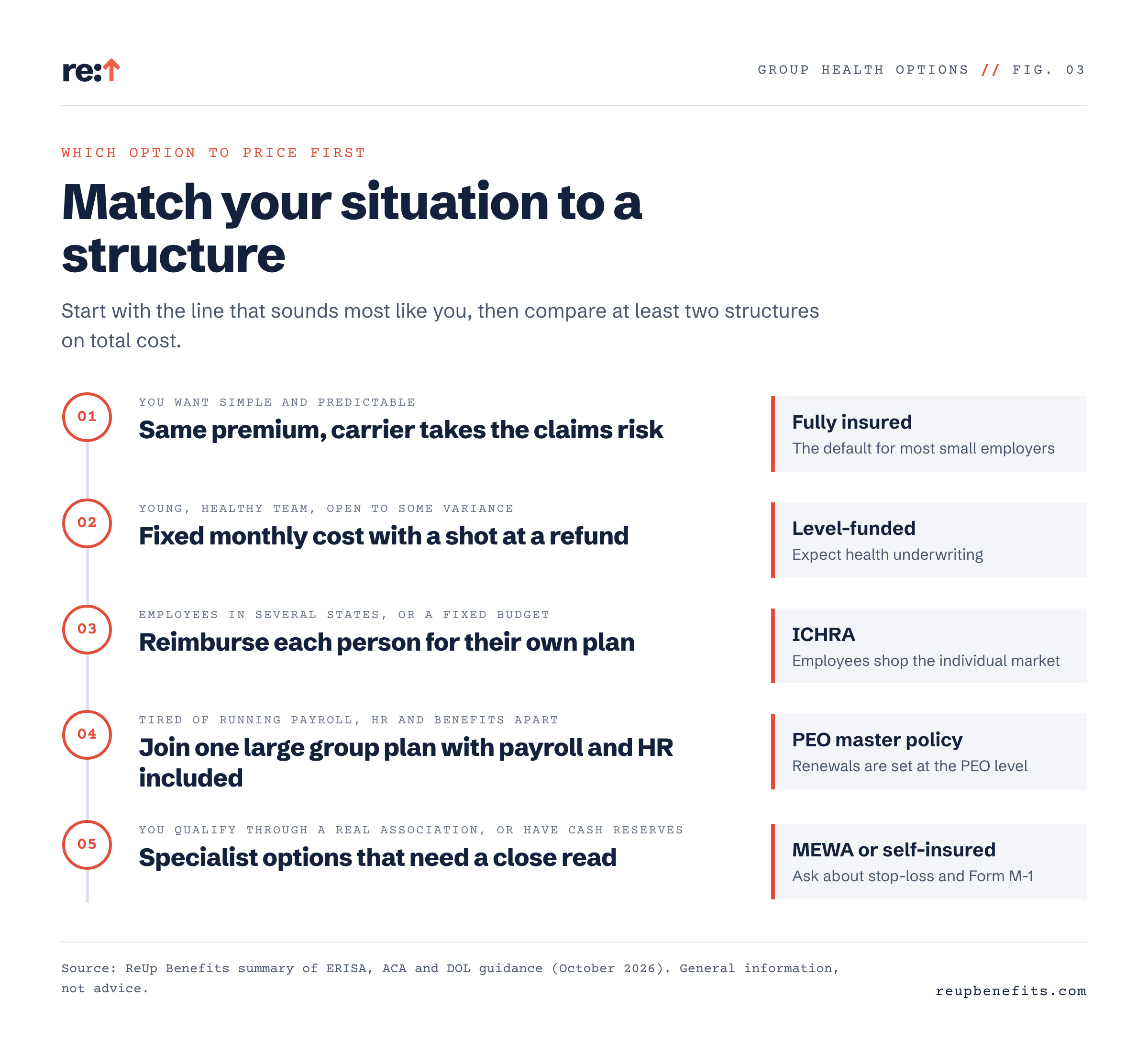
Whatever you pick, compare at least two structures side by side on total cost, not just the premium. Include the employee deductibles, the renewal history and what happens if a high-cost claim hits. For PEO pricing, see our PEO pricing guide.
How do I shop for group health insurance step by step?
Plan on starting at least a few months before your renewal or desired start date. In my experience, 90 to 120 days gives you room to quote, compare and enroll without a rushed decision. Here is the process I recommend.
- Gather your data. You need a census with each employee's age, ZIP code, coverage tier and any waived coverage, plus your current invoice and plan summaries.
- Set your budget and contribution. Decide how much of the premium you will pay for employees and for dependents.
- Quote more than one structure. Price fully insured, level-funded, ICHRA and PEO options, as they fit your size and state.
- Compare total cost, not just premium. Look at deductibles, copays, networks and what happens in a bad claims year.
- Check the underwriting and the fine print. Ask whether the quote is firm, what participation and contribution you need, and how renewals are set.
- Plan enrollment. Allow time for employees to choose plans and for the carrier to confirm that you met the participation rules.
Mistakes I see most often
The most common mistake is comparing premiums alone. The next is ignoring the renewal, since a first-year price can be a sales price. A third is picking a plan whose network does not include the doctors your team already uses. And a fourth is waiting until the last month, which removes your negotiating room. If you are weighing a PEO, our PEO renewal guide covers how renewals work.
Do I need a broker to buy group health insurance?
You can buy direct from a carrier, but most small employers get better results with an advisor who can quote several structures at once. The options above are not interchangeable, and each one has underwriting rules and trade-offs that a single carrier will not walk you through.
I spent more than ten years inside three PEOs, including as an account executive and sales manager at Justworks, so I know how these plans are sold and renewed from the inside. At ReUp Benefits I help small businesses compare fully insured, level-funded, ICHRA and PEO options side by side. If you are weighing a PEO, start with what a PEO broker does.
Not sure which structure fits? Book a 20-minute call with me. Bring your headcount, the states where your employees live, your current renewal or invoice, and a rough list of ages. I will tell you which options are worth quoting.
Frequently asked questions
What is the cheapest group health insurance for a small business?
There is no single cheapest option. Level-funded plans can cost less for healthy groups, fully insured plans offer predictability, and an ICHRA gives you a fixed budget. The lowest premium is not always the lowest total cost once deductibles and renewals are counted, so compare at least two structures.
How many employees do I need for group health insurance?
Requirements vary by carrier and state. In my experience, carriers usually want at least one employee besides the owners on the plan, and many set a minimum participation rate, often around 70% to 75% of eligible employees. A PEO or ICHRA can work for very small teams that struggle to meet carrier rules.
What is the difference between level-funded and self-insured?
Level-funded is a form of self-funding with a fixed monthly cost, built-in stop-loss insurance and a possible surplus refund. Fully self-insured plans have variable monthly costs because you pay claims as they occur. Level-funded is the lower-volatility version, which is why small employers use it.
What is the difference between a deductible, a copay and coinsurance?
A deductible is what you pay for covered care before the plan starts sharing costs. A copay is a flat fee for a specific service, like a doctor visit. Coinsurance is your percentage of a covered cost after the deductible, such as 20%. All three count toward your costs until you reach the out-of-pocket maximum.
What does underwriting mean in group health insurance?
Underwriting is how an insurer decides whether to cover your group and what to charge. In ACA small group, the price can only reflect age, tobacco use, family size and location. In level-funded, self-funded and many large group plans, your group’s health and claims can change the price, and the insurer can decline.
Can a carrier turn down my small business for group health insurance?
In fully insured small group, carriers must offer coverage, but they can require minimum participation and employer contribution. They can still decline if you do not meet those rules outside the annual enrollment window. Level-funded and self-funded plans use health underwriting, so they can decline or set higher limits for individuals.
Are MEWAs and association health plans safe for small businesses?
They can be, but it depends on whether the MEWA is fully insured or self-funded. A fully insured MEWA places claims risk on a carrier. A self-funded MEWA places it on the pool. Ask for the plan’s Form M-1 filing, stop-loss terms and reserve information before you join.
Is an ICHRA better than a group health plan?
An ICHRA is better for some teams and worse for others. It tends to win when employees live in different states or when you want a fixed budget. A traditional group plan tends to win when you want one shared plan and simple administration. Pricing both is the only way to know.
Does a PEO replace my need for health insurance?
No. A PEO sponsors a master health plan that your employees join, so you still offer health insurance, just through the PEO. You get access to its plans and pricing along with payroll and HR support, but the PEO sets the terms and renewals.
Can a small business join a PEO for health insurance?
Yes. Most PEOs accept small companies and offer their master policy as part of the service. Eligibility, carriers and pricing vary by PEO and by state, and PEO underwriting can look at your payroll and employee demographics.
Sources
This guide is general information, not legal, tax or insurance advice. Rules and prices change, and details vary by state and plan. Figures are as of October 2026.
- KFF, 2025 Employer Health Benefits Survey (2025)
- CMS, Market Rating Reforms (accessed October 2026)
- KFF, Small Group Market Rating Reforms by state (accessed October 2026)
- CMS, The 80/20 Rule: medical loss ratio rebates (June 2012)
- American Academy of Actuaries, comments on the impact of stop-loss insurance under the ACA (letter to the DOL) (June 2012)
- NAIC, Stop Loss Coverage model law chart (accessed October 2026)
- U.S. Department of Labor, MEWAs Under ERISA: A Guide to Federal and State Regulation (revised April 2022)
- U.S. Department of Labor, MEWAs and the ACA fact sheet (accessed October 2026)
- U.S. Department of Labor, COBRA employer eligibility (elaws) (accessed October 2026)
- 45 CFR 147.116, limits on waiting periods (accessed October 2026)
- IRS, employer shared responsibility provisions Q&A (accessed October 2026)
- IRS, Small Business Health Care Tax Credit and the SHOP Marketplace (accessed October 2026)
- NFP, IRS announces 2026 benefit limits (2025)
- HUB International, ACA affordability percentage for 2026 (August 2025)
- HUB International, final rules on reimbursing individual coverage (ICHRA) (June 2019)
- WTW, CMS releases revised 2026 out-of-pocket expense limits (July 2025)
- Mercer, 2026 HSA, HDHP and excepted-benefit HRA figures (June 2025)
- HealthInsurance.org, metal plans glossary (accessed October 2026)
- Becker's Payer, the One Big Beautiful Bill and employee benefits (July 2025)
- Word and Brown, small group special open enrollment (November 2024)