
By Cesar Figueroa, Owner, ReUp Benefits · Licensed health insurance and PEO broker
In this guide
What is the best PEO for health insurance? The best PEO for health insurance is the one whose carriers, networks and plan designs fit where your employees live and the doctors they use. PEO offerings differ more than most buyers expect. Aetna shows up at most PEOs, Cigna and Blue Cross Blue Shield are harder to find, and out-of-network coverage ranges from rich to thin.
Most rankings of the best PEOs for health insurance for small businesses score them on price, software and reviews. I'd start with the carrier list. I spent more than ten years inside three PEOs, and the question that decides whether employees like their new plan is simple: can they keep their doctors? If you're new to how PEO coverage works, start with our guide to what a PEO is in insurance.
Why does the carrier matter more than the PEO's name?
A PEO doesn't insure anyone itself. Its health plans are insured and run by carriers like Aetna or UnitedHealthcare, and the carrier sets the network: which doctors, hospitals and specialists count as in network. The PEO decides which carriers it works with, in which states, and which plan designs it offers through each one.
That's why two PEOs that both advertise big-company benefits can give your team very different access to care. Location matters too. TriNet, for example, tells clients that employees choose from plans based on home ZIP code eligibility. Your employee in Brooklyn and your employee in Austin can land on different carriers at the same PEO.
So the useful question isn't which PEO is best in general. It's which PEO has the right carrier where your people live, and no ranking of the best PEO companies for health insurance can answer that without your team's ZIP codes.
Which health insurance carriers does each PEO offer?
Here's what eight well-known PEOs publicly list as their medical carriers. Lineups change every plan year and vary by state, so treat this as a starting map, not a quote.
| PEO | Medical carriers named | How it works |
|---|---|---|
| ADP TotalSource | Aetna, Anthem (BCBS), Kaiser Permanente, UnitedHealthcare | Carriers depend on where you are located |
| TriNet | Aetna, Anthem BCBS, BCBS of Minnesota, BCBS of North Carolina, Blue Shield of California, Florida Blue, Harvard Pilgrim, Kaiser Permanente, UnitedHealthcare | Based on each employee's home ZIP code; the most Blue plans on this list |
| Insperity | UnitedHealthcare | Partner since 2002; contract extended through 2028 |
| Justworks | Aetna, UnitedHealthcare, Kaiser Permanente on its own plans; BCBS, UnitedHealthcare, Kaiser on open-market plans | Kaiser must be paired with Aetna or UnitedHealthcare; Blue plans are small group plans in certain states |
| Rippling PEO | Aetna nationally, Kaiser Permanente in some states, HMSA (BCBS) in Hawaii | Per its 2022 to 2023 benefits guide; check the current lineup |
| Sequoia One | Aetna, Blue Shield of California, Kaiser Permanente, UnitedHealthcare | Per Ignition Benefits' 2026 review |
| Engage PEO | Aetna, Kaiser Permanente | Aetna master medical plan since at least 2014 |
| G&A Partners | Cigna | Cigna master plan, added state by state |

Aetna is the most common PEO carrier
Six of the eight PEOs above list Aetna. Engage PEO has run its master medical plan with Aetna since at least 2014, and Rippling's PEO benefits guide names Aetna as its national carrier, with regional carriers added on top. If your team is spread across many states, you'll almost always find an Aetna option.
UnitedHealthcare anchors some of the largest PEOs
Insperity has offered UnitedHealthcare plans since 2002, and in November 2025 it extended that contract through 2028. ADP TotalSource, TriNet, Justworks and Sequoia One list UnitedHealthcare too. If your team's doctors aren't in UnitedHealthcare's network, check that before you look at anything else at Insperity.
Cigna is less common
Cigna shows up at far fewer PEOs. G&A Partners built its master health plan on Cigna and has expanded it state by state. When it brought that plan to Florida in 2022, it said it would be the only PEO in the state offering a Cigna plan. If your team is tied to Cigna doctors, your list of PEOs gets short fast.
Blue Cross Blue Shield is the hardest to find on a PEO plan
Blue Cross Blue Shield isn't one company. Each state or region has its own Blue plan, so a PEO has to sign them one at a time, and few build a national plan around them. Where Blues appear, they're usually regional. ADP lists Anthem, which is the Blue plan only in certain states, TriNet lists several state Blue plans, and Rippling's guide offered HMSA, Hawaii's Blue plan, only in Hawaii.
Justworks takes a different route. Its own master policies use Aetna, UnitedHealthcare and Kaiser, while Blue plans come through an open-market program in certain states. Those are small group plans priced by the carrier for your region, not part of Justworks' large group plan. That changes how your rates are set, so ask which kind of plan you're being quoted.
ADP TotalSource and TriNet have the widest carrier lists
ADP names Aetna, Anthem, Kaiser Permanente and UnitedHealthcare as medical partners, and the ones you see depend on where you're located. TriNet's 2025 renewal guide lists nine medical carriers, many of them regional Blue plans. For a company with employees in several states, these two usually give you the most combinations to work with.
Kaiser Permanente shows up at six of the eight, but only where Kaiser operates, and its plans are usually HMOs with no out-of-network coverage. That leads to the biggest difference most comparisons miss.
Why does out-of-network coverage vary so much between PEOs?
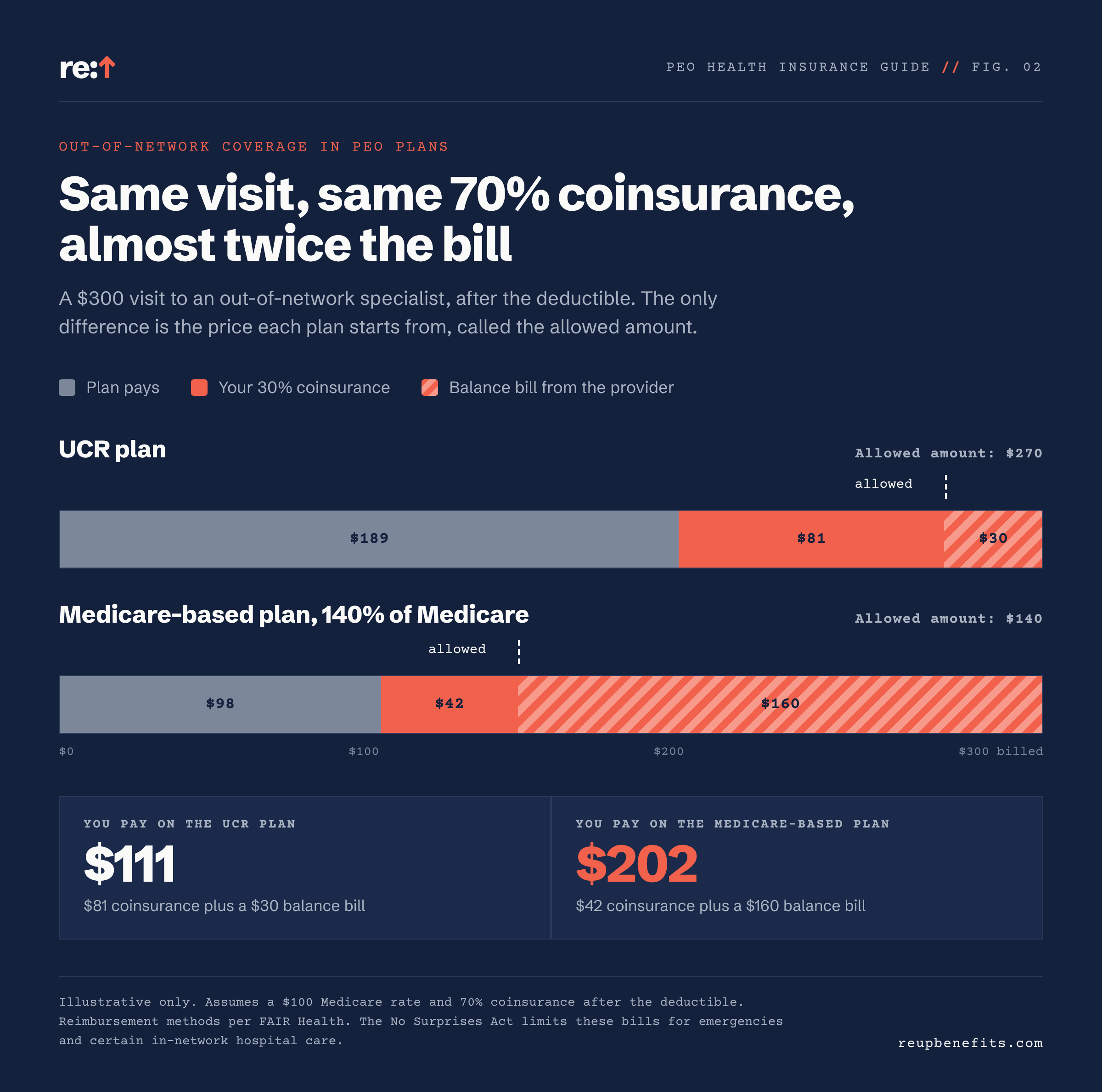
Out-of-network coverage is where PEO plans differ most, and it's the part most comparison charts skip. Two PPO plans can both list 70% out-of-network coinsurance and still pay very different amounts. The difference is the price the plan starts from, called the allowed amount.
FAIR Health, a nonprofit that publishes health care cost data, describes two common methods:
- UCR (usual, customary and reasonable). The plan starts from what providers typically charge for that service in your area.
- Medicare-based. The plan starts from a multiple of Medicare's fee, which FAIR Health notes is often less than what your doctor charges.
Whatever the plan doesn't allow, an out-of-network provider can bill you for. That's called balance billing. Take a $300 visit to an out-of-network specialist whose Medicare rate is $100, after the deductible, on two plans that each pay 70%. On a UCR plan that allows $270, the plan pays $189 and you pay $111. On a plan that allows 140% of Medicare, the plan pays $98 and you pay $202, almost twice as much for the same visit.
When does this matter? Since January 1, 2022, the No Surprises Act has protected patients from surprise out-of-network bills for emergency care and for certain care tied to an in-network hospital. Out-of-network benefits matter most for care your employees choose: a therapist who doesn't take insurance, a specialist outside the network, or a doctor they've seen for years.
New York shows how much the benchmark matters. Insurers there have to offer, on request, a plan that pays out-of-network care based on 80% of the 80th percentile of FAIR Health's charge data, unless the state grants an exemption.
Which PEOs have the best out-of-network benefits?
If out-of-network care matters to your team, this question can outweigh price. In my experience, TriNet offers some of the richest out-of-network plans in the PEO market, with out-of-network care reimbursed on a UCR basis. That includes the New York business TriNet added when it bought Ambrose, a New York City PEO, in 2013. TriNet isn't the only PEO with UCR-based plans, so ask every PEO you're considering. Our TriNet PEO review covers the rest of its plan lineup and what has happened to its pricing.
Insperity sits at the other end for this one feature. Its medical plans run through UnitedHealthcare, and in my experience it doesn't offer a UCR-based out-of-network option. That doesn't make Insperity a bad PEO. It makes it a weaker fit for a team that relies on out-of-network doctors.
Plan richness goes beyond out-of-network, too. Some PEOs build their lineups around low-deductible PPOs; others lean on high-deductible and HMO plans to keep premiums down. Neither is wrong, but know which one you're buying before you compare premiums. Our guide to PEO vs PPO explains how PPOs compare with HMO, EPO and POS plans.
Before you sign, ask each PEO for three things in writing:
- The summary of benefits and coverage for every plan your employees could pick.
- The out-of-network reimbursement basis for each plan: UCR or a percentage of Medicare, and which percentile or percentage.
- Whether any of it changes by state for the places your employees live.
How do you pick the best PEO for health insurance as a small business?
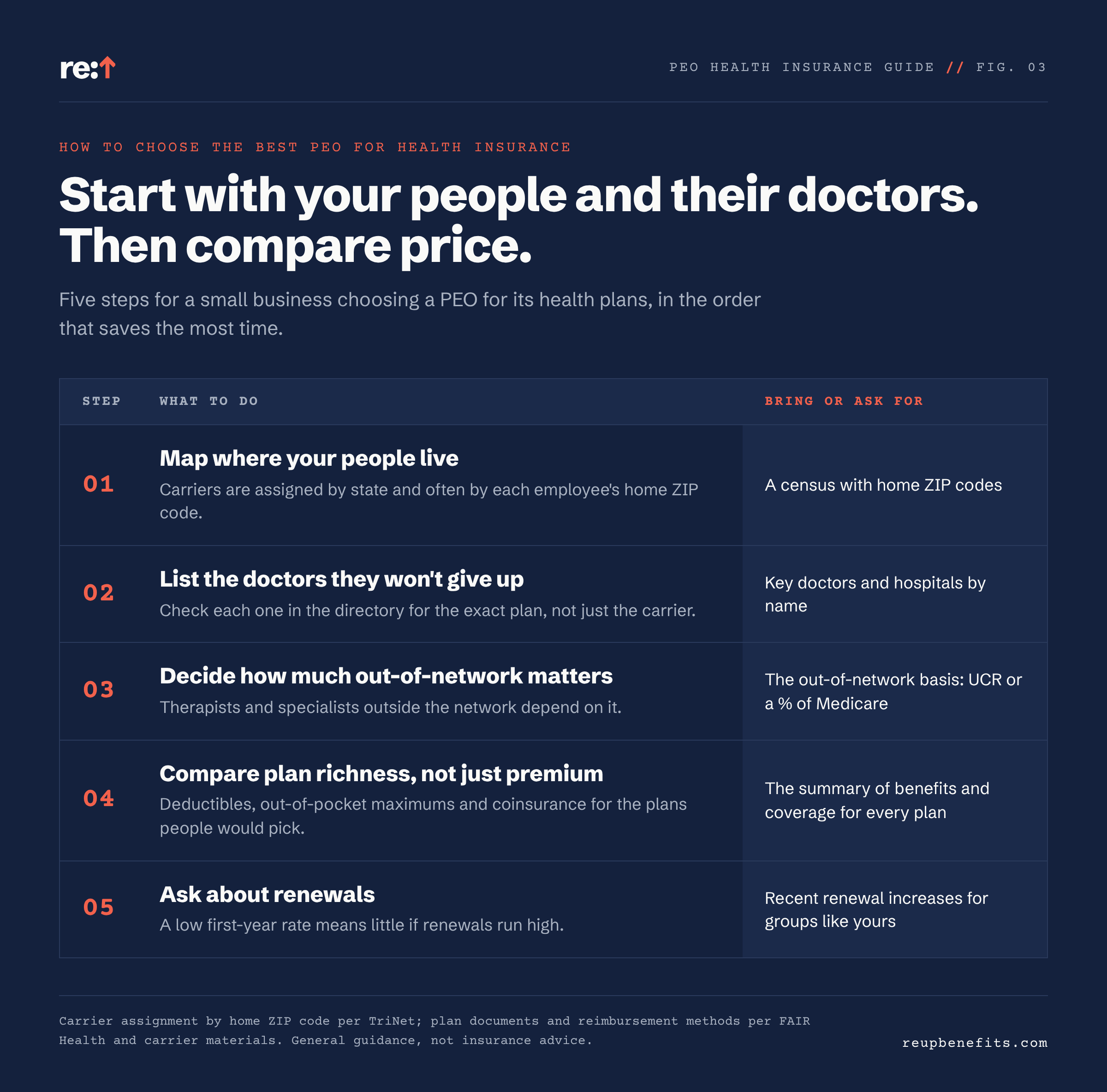
Whether you have 5 employees or 150, I'd work in this order:
- Map where your people live. Carriers are assigned by state and often by home ZIP code, so start with a census that includes ZIP codes.
- List the doctors your team won't give up. Check each one in the carrier's directory for the exact plan, not just the carrier.
- Decide how much out-of-network matters. If it matters, get the reimbursement basis in writing.
- Compare plan richness, not just premium. Line up deductibles, out-of-pocket maximums and coinsurance for the plans your employees would actually pick.
- Ask about renewals. A low first-year rate means little if renewals run high. We cover how PEOs price your group in PEO underwriting.
If you're a startup competing for hires, our guide to the best PEO for startups compares the plans and perks at Justworks, Deel and Rippling.
Or have a PEO broker run it for you: one census, every PEO whose carriers fit, and the plan documents side by side.
Frequently asked questions about PEO health insurance
What are the best health insurance plans for a PEO to offer?
The best health insurance plans for PEOs to offer give employees a real choice: at least one carrier with a strong network where they live, a PPO with UCR-based out-of-network coverage, an HSA-eligible high-deductible plan, and a lower-cost HMO or EPO where a strong local system like Kaiser Permanente exists. A lineup with only one carrier, or only high-deductible plans, leaves some employees without a good fit.
Can my employees keep their doctors if we join a PEO?
Only if those doctors are in network for a carrier and plan the PEO offers where each employee lives, or the plan has out-of-network coverage they're willing to use. Check the directory for the exact plan name before you sign.
Do all of my employees get the same carrier?
Not always. Carrier availability depends on state and often on each employee's home ZIP code, so a team split between New York and Texas may see different carriers and plans at the same PEO.
Is PEO health insurance cheaper than buying a plan on my own?
Sometimes. It depends on your census, your state and the PEO's pool. Our guide explains how PEO health plans are priced, underwritten and renewed.
Want to see which PEOs carry your team's doctors before you compare prices? Book a 20-minute review with me. Bring a census with ZIP codes and your current plan summary.
Sources
This article is general information, not legal, tax or insurance advice. Carrier lineups change every plan year and vary by state and ZIP code. Carrier lists are based on the public sources below, as of October 2026.
- ADP: TotalSource features
- TriNet: 2025 Benefits Strategy Solutions renewal guide
- TriNet: What's changing
- TriNet: TriNet acquires Ambrose (2013)
- Insperity: Third quarter results and new UnitedHealthcare contract (2025)
- TipRanks: Insperity and UnitedHealthcare extend partnership (2022)
- Justworks: Carrier eligibility requirements
- Justworks: Large group vs. open market health insurance
- Rippling PEO: National benefits guide, 2022 to 2023
- Ignition Benefits: Best PEOs for health insurance in 2026
- Engage PEO: Renews master medical plan with Aetna (2014)
- G&A Partners: Cigna master health plan in Florida (2022)
- FAIR Health: Types of out-of-network reimbursement
- FAIR Health: Protections for New York consumers
- CMS: Medical bill rights under the No Surprises Act