
By Cesar Figueroa, Licensed Health Insurance & PEO Broker, ReUp Benefits
In this guide
What is PEO compliance? PEO compliance is how a professional employer organization and your business split the legal work of being an employer. The PEO usually files payroll taxes, runs the benefit plans and prepares ACA and 401(k) filings. You still own the decisions behind them: who you hire, how you pay and classify people, and where they work.
"We handle compliance" is true for most of the paperwork and not true for the decisions that cause most compliance problems. I spent more than ten years inside three PEOs, including time as an account executive and sales manager at Justworks, and that gap is where I watched clients get surprised.
This guide covers PEO compliance area by area: co-employment, multi-state rules, federal HR laws, 401(k) and ACA reporting. For how PEO coverage works in general, start with our guide to what a PEO is in insurance.
Who is responsible for PEO compliance under co-employment?
Both of you, for different things. Co-employment splits employer duties under a written client service agreement. The PEO takes the filings that run through its systems. You keep the duties that come from directing the work.
Federal payroll tax shows where the line can move. The IRS says a business that uses a PEO generally keeps its own liability for employment taxes on its employees' wages, and advises due diligence before choosing one. The exception is a certified PEO (CPEO), which the IRS says is generally solely liable for employment taxes on wages it pays to your worksite employees. One catch from that same IRS page: customers cannot see a CPEO's deposits in EFTPS, the IRS payment system, so ask how the PEO proves your deposits were made.
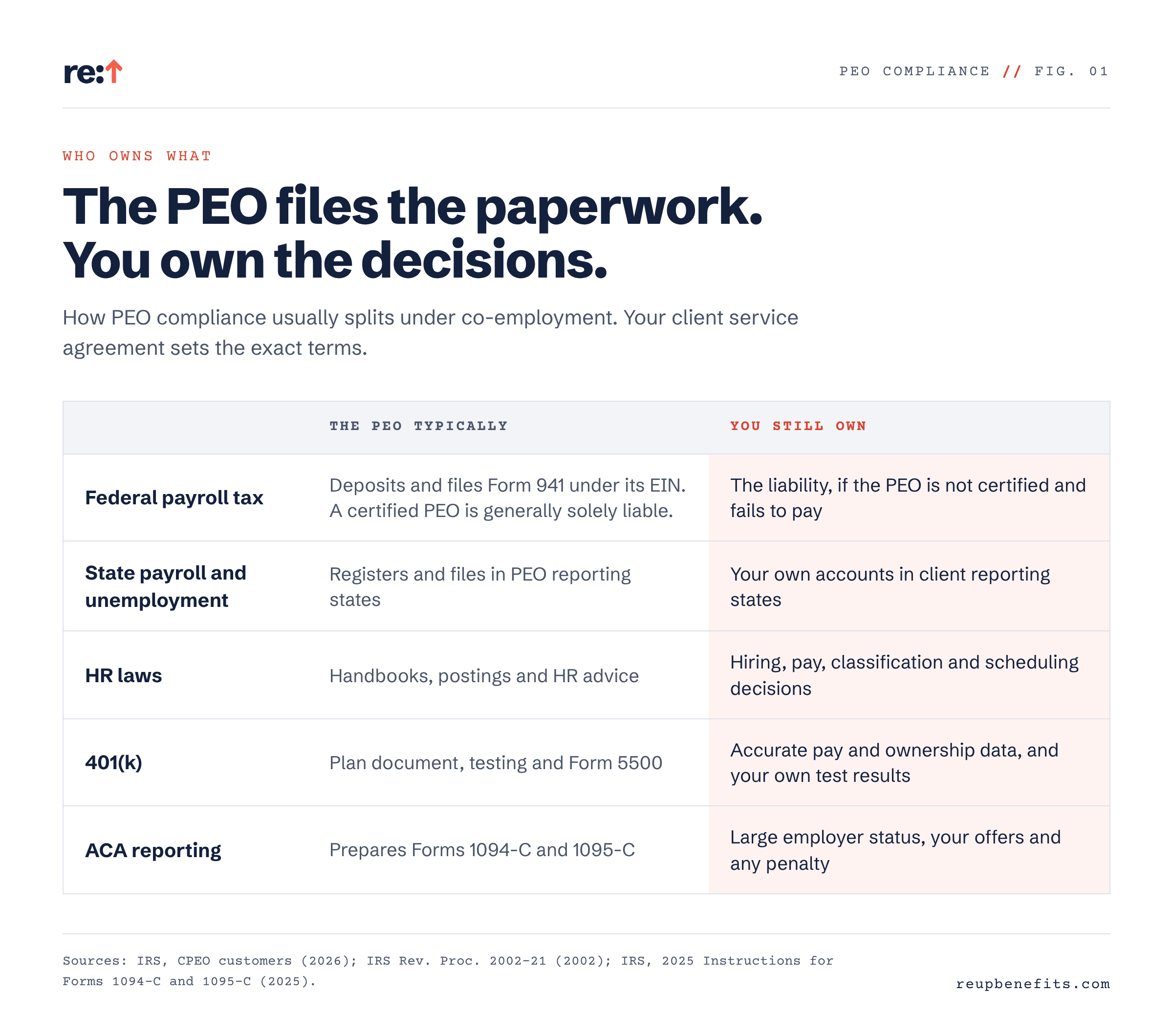
Here is how PEO compliance usually splits:
| Compliance area | What the PEO typically does | What stays with you |
|---|---|---|
| Federal payroll tax | Withholds, deposits and files Form 941 under its EIN | Liability if the PEO is not certified and fails to pay |
| State payroll and unemployment | Registers and files in states that allow PEO reporting | Your own accounts in client reporting states |
| Federal and state HR laws | Handbook templates, required postings, HR advice | Hiring, firing, pay, classification and scheduling decisions |
| 401(k) | Plan document, recordkeeping, testing, Form 5500 | Accurate pay, hours and ownership data, and your own test results |
| ACA reporting | Prepares Forms 1094-C and 1095-C | Your large employer status, the offers you make and any penalty |
In my experience, client service agreements say this plainly: the PEO relies on the data you give it, and decisions about pay, exempt status and hours are yours. For what happens when something goes wrong, see our guide to PEO risk management. Still weighing a payroll service instead? See PEO vs. payroll company.
How does a PEO handle multi-state compliance?
A PEO handles multi-state compliance by opening payroll tax and unemployment accounts in each state where your employees work, withholding state and local taxes, and tracking state leave and posting rules. It is also where gaps hide, because states treat PEOs differently.
PEO reporting states vs. client reporting states
In most states, a PEO reports wages and pays state unemployment tax under its own accounts. In client reporting states, such as Massachusetts, it must use your company's own accounts and rate. Mosey explains that those accounts are tied to your EIN, so registration, notices and deadlines land with you even if the PEO files. In my experience, this is the most common multi-state surprise: a state notice, addressed to the business, about an account the owner assumed the PEO owned.
The PEO itself has to be licensed
Many states license or register PEOs, and the rules vary enough that NAPEO, the industry's trade association, keeps a 50-state database of them. New York requires PEOs to register with the State Department of Labor every year. Ask for proof of licensing in each of your states. Our guides to PEO companies in New York and the Texas PEO buying guide cover those states in detail.
Paid leave and other state mandates
According to the U.S. Department of Labor, 13 states and DC have paid family and medical leave programs, and as of December 2024, 18 states and DC had paid sick leave laws. A PEO should enroll you in state programs and set up payroll contributions. You still approve leave and make sure no one is penalized for using it.
Workers' comp adds one more wrinkle: North Dakota, Ohio, Washington and Wyoming run state funds, so a PEO's private policy cannot cover employees there. See our guide to choosing a PEO in Ohio.
Which HR laws apply to you under co-employment?
Federal HR laws apply based on headcount, and co-employment does not switch them off. A PEO helps you meet them, but you remain an employer under each one.
| Law | Who it covers | Where the PEO helps |
|---|---|---|
| Title VII and the ADA | Private employers with 15 or more employees | Policies, training, accommodation guidance |
| ADEA (age discrimination) | Private employers with 20 or more employees | Policies and training |
| COBRA | Group health plans of employers with 20 or more employees | Notices and premium billing |
| FMLA | Private employers with 50 or more employees in 20 or more workweeks | Leave tracking and required notices |
| ACA employer mandate | Employers with 50 or more full-time employees, including equivalents | Offer tracking and Forms 1094-C and 1095-C |
Thresholds are from the EEOC, DOL and IRS. Under the DOL's FMLA rules, an employee also needs 12 months and 1,250 hours of service at a location with 50 or more employees within 75 miles. How co-employment affects headcount can differ by law, so ask the PEO to confirm in writing which laws apply to you and which threshold comes next.
Wage and hour law is where I see the most misplaced confidence. A PEO runs payroll as you set it up. If a manager is wrongly classified as exempt, the overtime is still owed, and in my experience the agreement puts classification on you.
PEO 401(k) compliance: testing, Form 5500 and what you still own
Most PEOs offer a 401(k) through a multiple employer plan that each client adopts. The PEO handles the plan document, recordkeeping, testing and the annual Form 5500. The compliance results are still calculated company by company.
Under IRS Rev. Proc. 2002-21, the guidance behind PEO retirement plans, nondiscrimination, coverage and top-heavy testing apply separately to each participating employer. Joining a big plan does not dilute your own test. If your owners and higher-paid staff save much more than everyone else, your company can fail, and common fixes are refunds to higher-paid employees or extra employer contributions.
According to NAPEO, the SECURE Act of 2019 removed the "one bad apple" rule for qualifying multiple employer plans, so one employer's failure no longer endangers the whole plan.
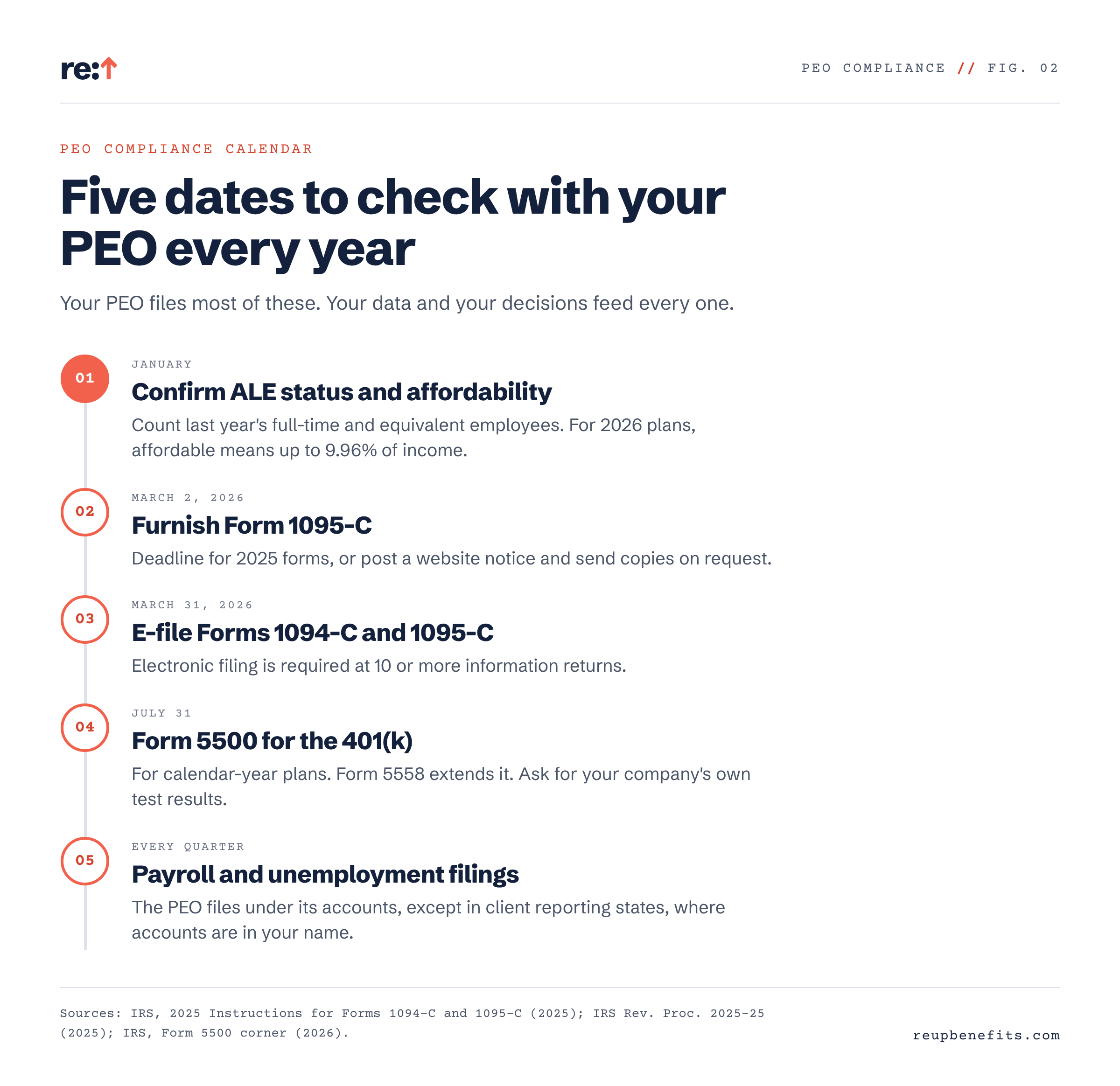
The IRS says Form 5500 is generally due on the last day of the seventh month after the plan year ends, July 31 for a calendar-year plan, and Form 5558 extends it. The penalty for not filing is $250 a day, up to $150,000. The PEO files it, but it can only report what it receives. Your part:
- Send accurate pay, hours and bonus data every payroll, because testing runs on it.
- Disclose ownership, including family members and related companies, so highly compensated employees are identified correctly.
- Ask for your company's own testing results each year.
- Review the fee disclosure and decide whether the costs are reasonable for your team.
PEO ACA reporting compliance: Forms 1094-C and 1095-C
If you averaged 50 or more full-time employees, including equivalents, last year, you are an applicable large employer (ALE) and must report your offers of coverage on Forms 1094-C and 1095-C. A PEO usually prepares them, but your ALE status, offers and any penalty stay with your business. The IRS instructions say each ALE member files under its own EIN. For the 2025 tax year, the deadlines were:
| Requirement | 2025 tax year deadline |
|---|---|
| Furnish Form 1095-C to full-time employees | March 2, 2026 |
| File with the IRS on paper | March 2, 2026 |
| File with the IRS electronically | March 31, 2026 |
Electronic filing is required once you file 10 or more information returns in a year, counted together with returns like Forms W-2. For the 2025 tax year, the penalty was $340 per return not filed correctly, plus $340 per employee statement not furnished correctly. The instructions also describe a newer option: post a clear notice on your website and send Form 1095-C within 30 days of a request instead of mailing every copy. Ask your PEO whether it uses that option, and whose website hosts the notice.
The reporting only holds up if the offers behind it do. For 2026 plan years, coverage is affordable if the employee's share of self-only coverage is no more than 9.96% of household income, measured through an IRS safe harbor. The 2026 penalties are $3,340 per full-time employee beyond the first 30 if you do not offer coverage to enough people, and $5,010 for each full-time employee who gets a subsidized marketplace plan because your offer fell short. Whether a PEO plan's offer counts as yours depends on how fees are charged, as the ACA section of our main guide explains. For enrollment and COBRA, see PEO benefits administration.
PEO compliance checklist: what to confirm before you sign
Ask these during the sales process and get every answer in writing.
- Is the PEO on the IRS list of certified PEOs? If not, how does it prove your tax deposits?
- Is it licensed or registered in every state where you have employees?
- Which of your states are client reporting states, and who files there?
- Who handles local taxes and state paid leave contributions?
- Which federal HR laws apply to you now, and at your next headcount threshold?
- Who files and furnishes your Forms 1094-C and 1095-C, and under which EIN?
- Will you see your own 401(k) testing results each year?
- Who pays penalties caused by late or wrong data, and what does the indemnification clause say?
If a PEO answers these clearly, its compliance support is probably real. If the answers are vague, treat that as the answer. Running these questions across several PEOs is the work a PEO broker does, and as a licensed health insurance and PEO broker I can also quote group health options outside a PEO.
Want a second set of eyes on a PEO's compliance terms? Book a 20-minute call with me. Bring the client service agreement, a list of the states where your employees live and work, and last year's Forms 1095-C or 401(k) testing results if you have them.
Frequently asked questions about PEO compliance
Does a PEO make my business compliant?
No. A PEO takes on much of the filing work and gives you HR guidance, but you remain an employer. Decisions about hiring, pay, classification, scheduling and safety stay with you, and so does liability for most problems they cause.
Is my PEO responsible for ACA reporting?
Usually the PEO prepares and files Forms 1094-C and 1095-C, but the obligation belongs to each applicable large employer under its own EIN. If the forms are late or wrong, or your offers fall short, the penalty is assessed to your business. Confirm in writing who files and who pays if something is missed.
Who files Form 5500 for a PEO 401(k)?
The PEO, as sponsor of the multiple employer plan, generally files one Form 5500 for the whole plan, and since the SECURE Act that filing must list each participating employer. Testing is still done separately for your company, so your data has to be right.
What is the difference between a PEO and a CPEO for compliance?
A CPEO is a PEO the IRS has certified. It is generally solely liable for federal employment taxes on wages it pays to your worksite employees, while with a non-certified PEO that liability can come back to you. Certification covers federal employment taxes only, not state taxes, HR laws or benefit plan rules.
Sources
This article is general information, not legal, tax or insurance advice. Rules change and vary by state, so confirm details with the agency or a qualified advisor before acting. Figures are as of October 2026 unless a different date is shown.
- IRS: CPEO customers, what you need to know (October 2026)
- IRS: CPEO public listings
- IRS: Third party payer arrangements, professional employer organizations
- IRS: 2025 Instructions for Forms 1094-C and 1095-C (October 2025)
- IRS: Rev. Proc. 2025-25, 2026 affordability percentage (July 2025)
- IRS: Rev. Proc. 2025-26, 2026 employer shared responsibility amounts (July 2025)
- IRS: Questions and answers on employer shared responsibility provisions
- IRS: Rev. Proc. 2002-21, PEO retirement plans (May 2002)
- IRS: Form 5500 corner (July 2026)
- NAPEO: PEOs and retirement regulation (SECURE Act)
- NAPEO: Regulatory database
- New York State Department of Labor: Professional employer organizations
- U.S. Department of Labor, Women's Bureau: Paid leave (December 2024 sick leave count)
- U.S. Department of Labor: Family and Medical Leave Act (January 2026)
- U.S. Department of Labor: COBRA
- EEOC: Coverage
- Mosey: Client reporting states and PEOs (November 2024)