
By Cesar Figueroa, Owner, ReUp Benefits · Licensed health insurance and PEO broker
In this guide
What should you know before choosing a PEO in Ohio? Ohio sells workers' comp only through its state fund, the BWC, so a PEO cannot shop carriers for you. The PEO must register with BWC and report your payroll and claims. Your real questions are whose experience rating prices your policy, who keeps the dividends, and what comes back to you when you leave.
I spent more than ten years inside three PEOs, and Ohio is the state where the usual PEO pitch changes the most. In Ohio the state sets the workers' comp price for everyone. Below: how BWC works, what Ohio law requires of a PEO, and what to ask before you sign. New to PEOs? Start with our guide to what a PEO is in insurance.
Why can't a PEO shop workers' comp carriers in Ohio?
Because Ohio does not let private carriers sell workers' comp. Ohio is one of four states with a monopolistic state fund, along with North Dakota, Washington and Wyoming. The Ohio Bureau of Workers' Compensation (BWC) is the exclusive provider, and it says it serves 258,000 public and private employers.
That changes what a PEO can do for you. In most states a PEO's pitch includes a bigger pool or a better carrier program than you could buy alone. In Ohio, BWC sets base rates per $100 of payroll for each class code, effective each July 1. Workers a PEO assigns to you are classified the same as your own employees doing the same job, so a PEO cannot move your payroll into a cheaper code.
| Most states | Ohio | |
|---|---|---|
| Who sells workers' comp | Private carriers, sometimes a state fund too | BWC only |
| Who sets the base rate | Carriers file their own rates | BWC's board, by class code, each July 1 |
| Where a PEO can change your cost | Carrier program, pooling, pricing | Experience rating, add-on charges, dividend pass-through |
| How you pay | Deposit and audit, or PEO pay-as-you-go | BWC installments and true-up, or PEO monthly billing |
A monopoly does not mean high prices here. BWC says Ohio employers are paying the lowest rates in more than 65 years, and Oregon's most recent rate study ranked Ohio fifth-lowest among the states and D.C.
So where can a PEO in Ohio change your workers' comp cost? In three places: the experience rating applied to your payroll, any charge the PEO adds on top of BWC's premium, and whether dividends reach you. Pay-as-you-go billing is a smaller selling point too, because BWC already bills estimated premium in installments with an annual true-up.
BWC policies do not include employer's liability, so businesses buy stop gap coverage separately. Ohio's PEO law says shared employees are not treated as PEO employees for liability coverage unless the agreement says so (ORC 4125.041). Ask who holds yours.
How is a PEO in Ohio regulated, and how do you check one?
Ohio regulates PEOs through BWC. Under Ohio Revised Code Chapter 4125, a PEO operating in the state must register with BWC within 30 days of formation and renew by December 31 every year. I did not find a separate state PEO license in Ohio, so the BWC registration is the check that matters.
The law also adds financial safeguards. A PEO must file audited financial statements, and the auditor's report cannot raise substantial doubt about the PEO's ability to continue. The PEO must also keep positive working capital or post a bond, letter of credit or securities to cover the shortfall, and BWC may require security sized to the PEO's most recent policy-year premium.
Checking takes two minutes. BWC runs a public PEO look-up where you search by name or policy number and see registration and certification status. BWC says it recognizes only PEOs that are registered and in compliance. Some small out-of-state PEOs can hold a limited registration, which covers up to 50 shared employees in Ohio and no Ohio office.
If BWC revokes a registration, for reasons such as misappropriating client funds, each client must report payroll and pay BWC directly at a rate based solely on its own claims experience. Two more details:
- The term. Ohio defines a PEO agreement as a written contract of at least 12 months, so read the term and termination language closely.
- PEO or AEO. Ohio also registers alternate employer organizations. An AEO runs payroll under your own federal tax ID and lists you on the W-2, while a PEO pays wages under its own. Confirm which one you are signing with.
BWC registration is not IRS certification. For federal payroll tax liability, check the IRS list of certified PEOs.
Whose experience rating do you get with an Ohio PEO?
It depends on how your payroll is reported to BWC. When you sign with a PEO, the PEO becomes the succeeding employer for workers' comp experience. BWC prices a policy by comparing actual losses with expected losses over the oldest four of the latest five completed policy years. If your payroll is reported under the PEO's policy, your history is combined with the PEO's other clients in what BWC calls a combined experience modifier.
Ohio also allows the other arrangement. A PEO may report all of your workers' comp payroll under your own policy number, even though it pays wages under its federal tax ID, and then your own experience sets your rate. Either way, you must keep an active BWC account of your own.

BWC's rules exclude PEO policies from two adjustments other experience-rated employers receive, the EM adjustment factor and the premium size factor. I cannot tell you which way that cuts for your business. Ask the PEO for the BWC rate it charges for each class code and compare it with your own BWC rate notice.
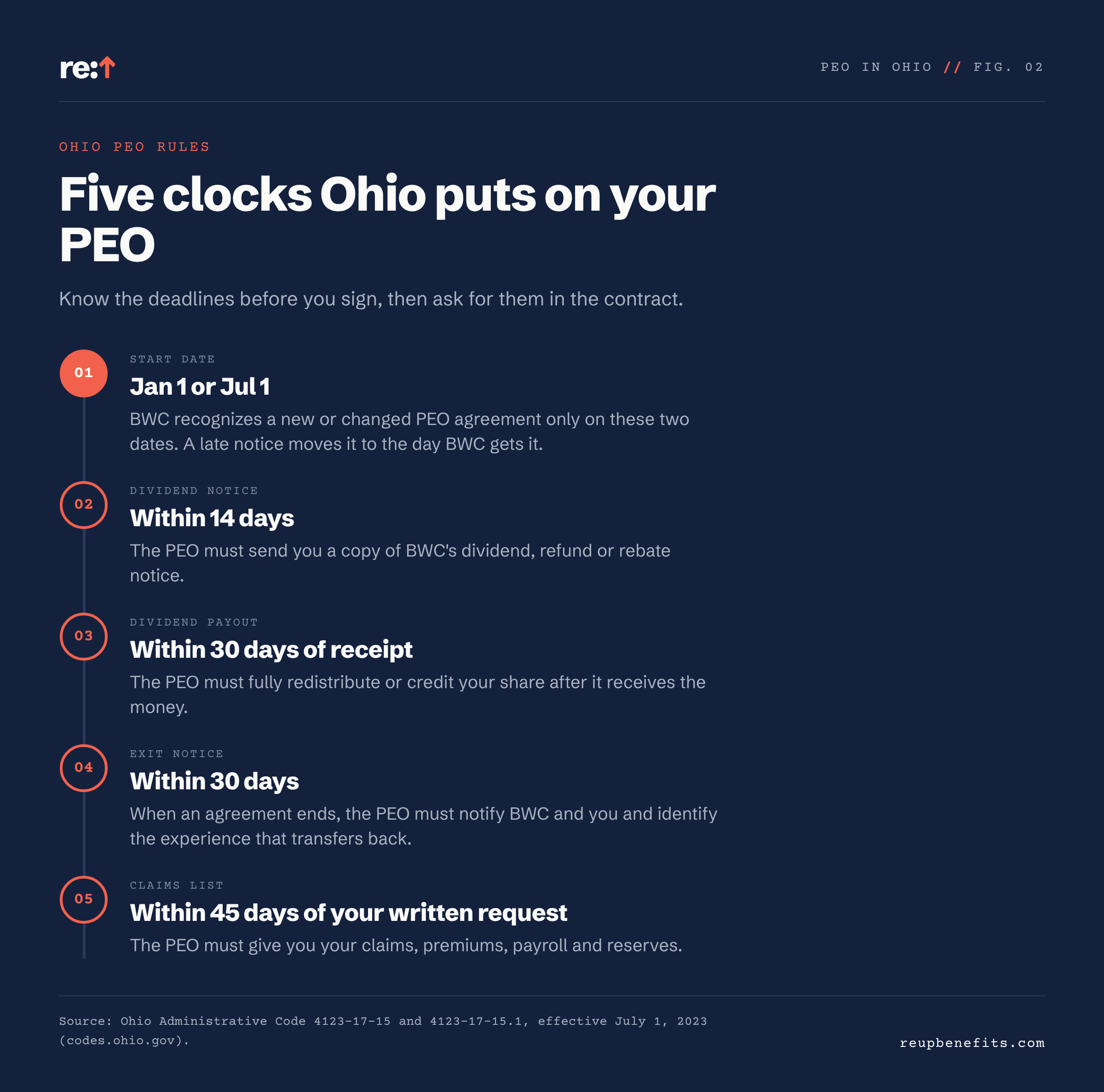
Start dates matter too. BWC recognizes a new or changed PEO agreement only on January 1 or July 1, and if the PEO notifies BWC late, the recognized date moves to the day BWC receives the notice. Until then you keep reporting under your own policy, so a mid-period start can leave you with two sets of paperwork.
Leaving works in your favor on paper. When an agreement ends, the PEO must notify BWC and you within 30 days and identify the experience that transfers back to you. It must also give you a list of your claims, premiums, payroll and reserves within 45 days of your written request. Ask for that list before you give notice, so you can shop with it.
Do BWC dividends reach you through an Ohio PEO?
They should, and Ohio's rules say how. On August 28, 2026, BWC's board approved a $1 billion dividend worth about 90% of premiums paid in policy year 2022, with checks going to eligible employers through September and October, according to BWC's statement.
If a PEO's policy paid the premium, the PEO receives the money, not you. Ohio's rule requires the PEO to send you a copy of BWC's dividend, refund or rebate notice within 14 days and, within 30 days of receiving the money, to fully redistribute or credit your share. If your payroll sat under a PEO's policy in 2022, ask whether your share arrived and when.
What else changes the cost of a PEO in Ohio?
Unemployment tax. Ohio taxes the first $9,000 of each employee's wages. The 2026 new employer rate is 2.85%, and every contributory employer also pays a 0.15% Technology and Customer Service Fee on that wage base in 2026 and 2027. Ask which rate the PEO bills you and whether the fee is passed through at cost.
Health plan pricing. Ohio's small employer rules cover employers with two to 50 eligible employees and exclude claims experience and health status from pricing. But a fully insured PEO plan is not subject to those sections when the PEO itself is not a small employer. That can reward a healthy group and cost an older one, so get a side-by-side quote. Our guides to PEO underwriting and the best PEO for health insurance explain how.
Fees and risk class. I did not find an Ohio-specific PEO price list. Fees follow the national structure, which our guide to average PEO fees breaks down. If you run manufacturing, construction or trucking, some PEOs will decline you, and our guide to high risk PEO service shows who does not.
What should you ask before signing with an Ohio PEO?
Get these answers in writing before you sign:
- Is the PEO registered with BWC, and is it registered as a PEO or an AEO?
- Will my payroll be reported under the PEO's BWC policy or my own?
- What BWC rate per $100 will I pay for each class code, and what does the PEO add on top?
- Can I see the PEO's audited financial statements, and does it post a bond or other security?
- How and when do you pass through BWC dividends, refunds and rebates?
- Who carries stop gap employer's liability coverage for my business?
- Which start date will BWC recognize, January 1 or July 1?
- Which unemployment rate will you bill, and who files my city income tax withholding?
- What are the term, the notice period and the exit steps, including my claims list and experience transfer?
A PEO broker can run this comparison across several PEOs at once. Want a second set of eyes on an Ohio proposal? Book a 20-minute call with me. Bring your BWC rate notice, your class codes and payroll, and the PEO proposal, and I will break it down line by line.
Frequently asked questions about a PEO in Ohio
Does a PEO in Ohio have to be registered?
Yes. A PEO operating in Ohio must register with the Ohio Bureau of Workers' Compensation within 30 days of formation and renew by December 31 each year, and it must file audited financial statements. BWC says it recognizes only registered PEOs that are in compliance, so check its public lookup before you sign.
Can a PEO get me cheaper workers' comp in Ohio?
Not by finding a cheaper carrier, because BWC is the only one. A PEO can change which experience rating prices your payroll, what it adds on top of BWC's premium, and how dividends reach you. Compare its rate for each of your class codes with your own BWC rate notice.
Do I still need my own BWC account if I use a PEO?
Yes. Ohio requires each client employer to establish and keep an individual BWC account, even when the PEO reports your payroll under its own policy.
What happens to my claims history if I leave an Ohio PEO?
BWC moves the experience tied to your business back to you. The PEO must send termination notices to BWC and to you within 30 days, and it must give you a list of your claims, premiums and payroll within 45 days of a written request.
Can an Ohio PEO be self-insured for workers' comp?
Yes. A PEO can qualify for BWC self-insurance, and BWC then applies the self-insurance security rules in place of the standard PEO security rules. Ask which program your PEO uses and who manages your claims.
Sources
This guide is general information, not legal, tax or insurance advice. Ohio rules, BWC rates and PEO pricing change, so confirm current requirements with BWC, the Ohio Department of Job and Family Services and a qualified advisor before acting. Figures are as of October 2026 unless a different date is shown.
Government and law
- Ohio Revised Code Chapter 4125, Professional Employer Organizations (checked October 2026)
- Ohio Administrative Code 4123-17-15, AEOs and PEOs (effective July 1, 2023)
- Ohio Administrative Code 4123-17-15.1, AEO and PEO agreements (effective July 1, 2023)
- Ohio Administrative Code 4123-17-03, employer's experience rating plan (checked October 2026)
- Ohio Administrative Code 4123-17-03.3, employer premium size factors (effective July 1, 2024)
- Ohio Administrative Code 4123-17-06, private employer base rates per $100 of payroll (effective July 1, 2026)
- Ohio Administrative Code 4123-17-08, classifications and PEO workers (effective July 1, 2026)
- Ohio Revised Code 3924.01, small employer definitions (effective April 9, 2025)
- Ohio BWC: AEO and PEO look-up (checked October 2026)
- Ohio BWC: PEO guidelines, combined experience modifier (checked October 2026)
- IRS: CPEO public listings
Workers' comp news and rates
- Toledo Legal News: Governor DeWine applauds approval of $1 billion dividend, BWC statement (fall 2026)
- WorkCompCentral: BWC approves $1 billion dividend (August 31, 2026)
- Business Insurance: Ohio approves $1 billion comp dividend (2026)
- Business Insurance: Ohio governor seeks approval for $1B workers comp dividend (July 2026)
- Sheakley: Ohio employers to receive $1 billion BWC dividend (2026)
- Dayton Area Chamber: BWC premium installment and true-up reporting (2026)
- The Hartford: stop gap coverage in monopolistic states
Payroll taxes
- Ernst & Young: Ohio law imposes new employer SUI surcharge starting in 2026 (November 24, 2025)
- Eddy: 2026 new employer rates and SUI wage base limits (December 2025)