
By Cesar Figueroa, Owner, ReUp Benefits · Licensed health insurance and PEO broker
In this guide
What is PEO benefits administration? It's the work a PEO does to run your employee benefits. Your employees join the PEO's master plans, and the PEO negotiates with carriers, runs open enrollment, deducts premiums through payroll, pays the carriers, and handles COBRA and ACA reporting. You still decide which plans to offer and what you contribute.
I spent more than ten years inside three PEOs, and benefits are the reason most small businesses I talk to look at one in the first place. This guide covers which PEO benefits you get, who handles which part of the work, how a benefits year runs, and how to judge one PEO's benefits administration against another. For the bigger picture of how PEOs handle insurance, start with our guide to what a PEO is in insurance.
What is PEO benefits administration?
Benefits administration is everything it takes to offer benefits and keep them running: picking carriers and plans, enrolling employees, processing changes, collecting premiums, paying carriers, sending required notices and filing required forms.
A PEO does this differently from a broker or a software tool because of co-employment. The PEO sponsors its own master health and retirement plans, and your employees join them as worksite employees of the PEO. That's what gives a 15-person company access to plans negotiated for tens of thousands of employees. It's also why the PEO, not you, carries most of the administrative work.
What benefits do PEOs offer?
Most PEO benefits packages include:
- Health coverage: medical, dental and vision, usually with several plan options from one or more carriers.
- Retirement: a 401(k) through the PEO's plan, with testing and filings handled for you.
- Life and disability insurance: basic life, plus short- and long-term disability.
- Pre-tax accounts: HSAs, FSAs and commuter benefits.
- Extras: employee assistance programs and voluntary benefits like pet or legal insurance.
The access gap is real. In KFF's 2025 Employer Health Benefits Survey, 59% of firms with fewer than 200 workers offered health benefits, against 97% of larger firms. On retirement, NAPEO reports that 52% of PEO clients with 10 to 49 employees offer a retirement plan, compared with 23% of similar companies that don't use a PEO (2026).
Which carriers you get depends on the PEO and your state. Our guide to the best PEO for health insurance compares carriers by PEO.
What is the role of a PEO in benefits administration?
The PEO runs the process. You make a handful of decisions and keep it fed with accurate information. Here's how the work usually splits:
| Task | Usually the PEO | Usually you |
|---|---|---|
| Carriers and plans | Negotiates master plans and renewals | Choose which plans to offer |
| Contributions | Sets the allowed range | Decide how much you pay |
| Open enrollment | Runs the portal, plan guides and deadlines | Remind employees and approve |
| Payroll deductions | Deducts premiums and pays carriers | Fund the PEO invoice |
| New hires and life events | Processes enrollments and changes | Report hires and exits on time |
| COBRA | Sends notices and bills participants | Report who left and why |
| ACA reporting and 401(k) filings | Prepares forms and plan filings | Confirm the data is right |
| Employee questions | Benefits help desk | First point of contact |
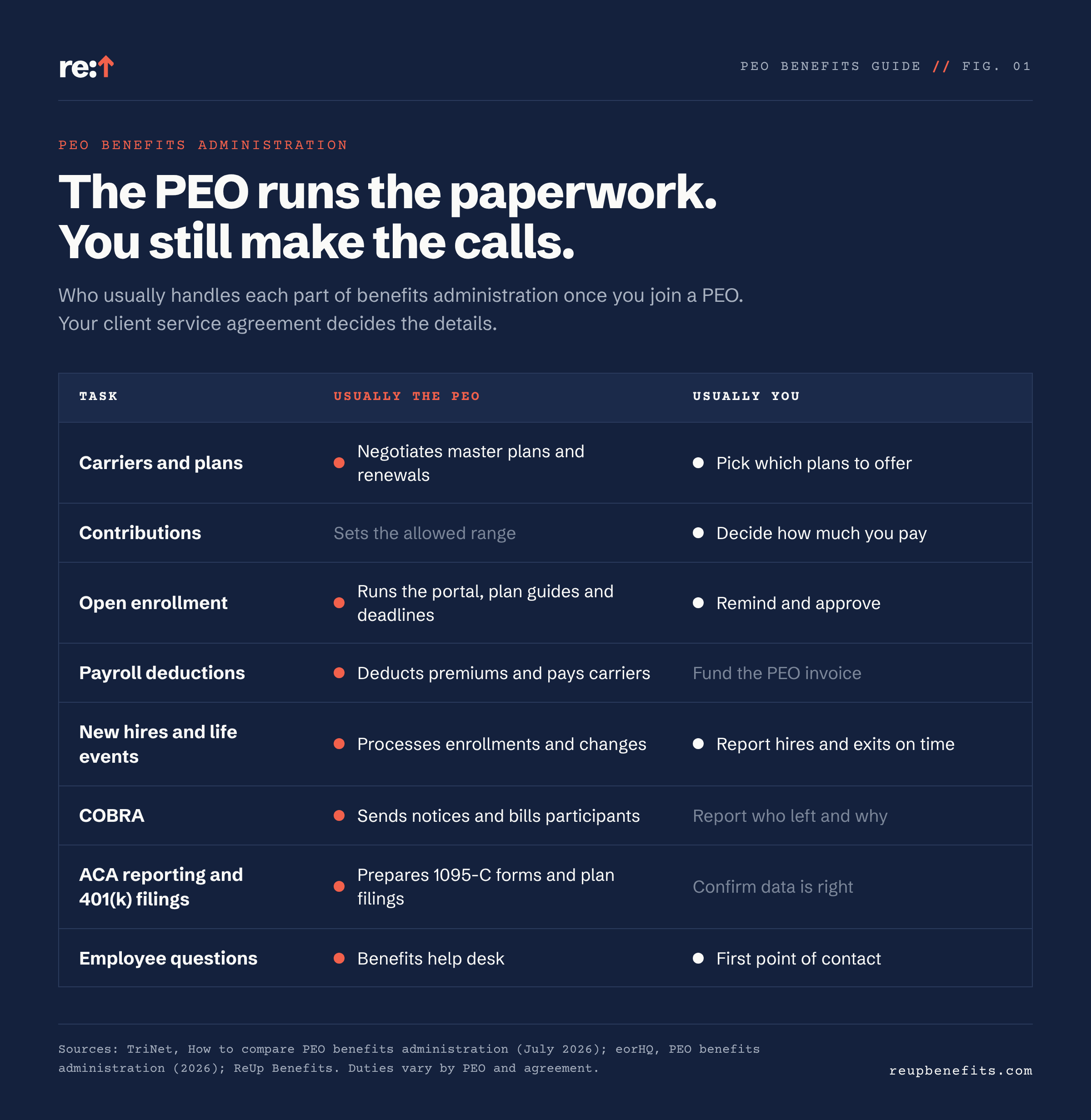
Two things in that table get missed. First, the PEO only knows what you tell it. A termination reported three weeks late can mean an extra month of premium, a late COBRA notice, or both. Second, compliance help isn't legal advice. TriNet's own guide to comparing PEO benefits administration (July 2026) makes that point. The PEO handles the filings; you still own your decisions.
How does PEO benefits administration work?
It runs on a yearly cycle:
- Renewal. Before your plan year, the PEO negotiates its master plans and sends your new rates. How those rates are set is covered in our guide to PEO underwriting.
- Plans and contributions. You pick which plans to offer and how much you'll pay toward them.
- Open enrollment. Employees choose plans in the PEO's portal. The PEO sends elections to the carriers.
- Every payroll. Premiums come out of paychecks, and the PEO pays the carriers.
- Year-round changes. New hires, marriages, births and departures are processed as they happen, including COBRA for people who leave.
- Year-end. ACA forms and 401(k) testing and filings.
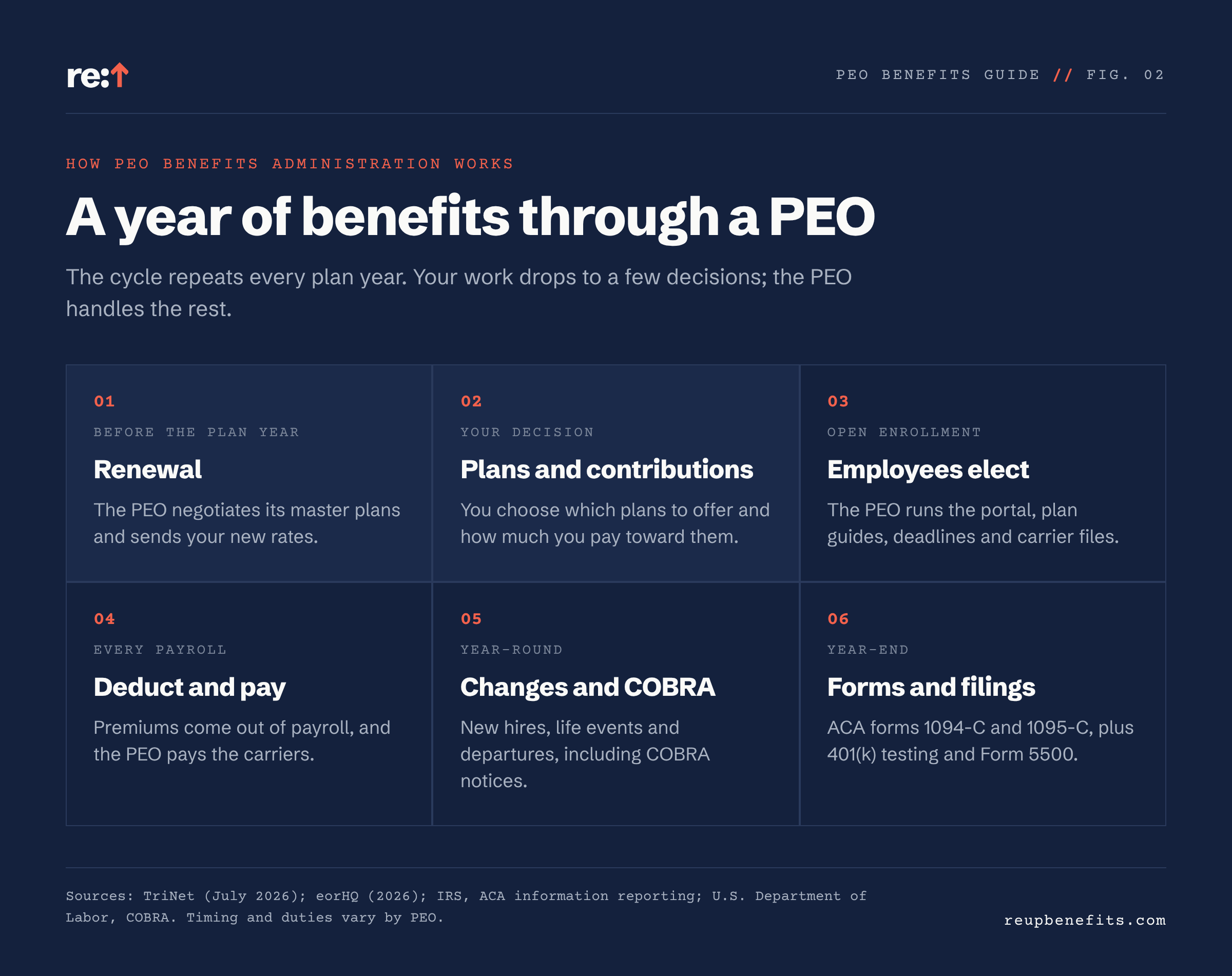
The year-end filings matter more than people expect. Employers with 50 or more full-time or full-time equivalent employees must file Forms 1094-C and 1095-C under the ACA each year (IRS). Federal COBRA generally applies to employers with 20 or more employees (U.S. Department of Labor), and many states have their own continuation rules for smaller groups. Ask every PEO whether this work is in the base fee or billed separately. For the filing deadlines themselves, see our guide to PEO compliance. Our ACA section in the main guide goes deeper.
Can a PEO reduce your HR administrative burden?
Yes, for the paperwork. Without a PEO, a small company running benefits on its own deals with a broker, one or more carriers, a COBRA vendor, a 401(k) provider and whoever prepares its ACA forms. A PEO puts all of that behind one contract and one invoice.
What it doesn't remove is the decision-making, and it comes with trade-offs:
- You pick from a menu. The PEO's plans are what's available. If your team needs a carrier the PEO doesn't offer in your state, that's a real limit.
- Renewals reflect the pool. Your rates move with the PEO's claims experience, not only yours.
- Leaving means changing plans. The plans belong to the PEO, so exiting usually means new plans and new ID cards for everyone. We cover that in what happens when you leave a PEO.
Which PEO offers the best benefits administration for small businesses?
There isn't one answer, because the best PEO depends on where your employees live and what they need. A PEO with great plans in Texas can be thin in New York. When I compare PEOs on benefits administration, these are the questions that separate them:
- Which carriers and how many plan options are available in your employees' ZIP codes?
- How flexible are contributions? Can you contribute differently by employee class, or only one flat percentage?
- How good is the enrollment experience? Ask for a demo of what an employee actually sees.
- Who answers your employees' benefits questions, and how fast?
- Is COBRA, ACA reporting and 401(k) administration included, or billed separately?
- How have renewals run for groups like yours over the last few years?
Get those answers in writing from every PEO you're considering. That side-by-side comparison is the work a PEO broker does for you.
Frequently asked questions about PEO benefits
Is benefits administration included in the PEO fee?
Usually, though sometimes only on a higher tier. Justworks, for example, includes medical, dental and vision administration in its $124 Plus plan, not its $79 Basic plan (October 2026). Premiums are always billed on top. See our breakdown of average PEO fees for small businesses.
Do PEOs help with health insurance administration?
Yes. It's the core of PEO benefits administration: enrollment, changes, premium billing, carrier payments and employee support.
Can I keep my current health plan if I join a PEO?
Sometimes, but most of the value comes from the PEO's own master plans. Ask each PEO whether it allows a plan you sponsor yourself, and what it charges to administer one.
Does a PEO make my company compliant automatically?
No. A PEO takes on much of the filing and notice work, but you still need to report hires, exits and changes on time and make sound decisions about eligibility and contributions.
Want to know whether a PEO's benefits fit your team? Book a 20-minute review with me. Bring your current benefits summary or a PEO proposal.
Sources
This article is general information, not legal, tax or insurance advice. Plans, carriers and duties vary by PEO, state and contract. Figures are as of October 2026 unless a different year is shown.
- KFF: 2025 Employer Health Benefits Survey
- NAPEO: Industry statistics (2026)
- TriNet: How to compare PEO benefits administration (July 2026)
- eorHQ: PEO benefits administration (2026)
- IRS: Information reporting by applicable large employers
- U.S. Department of Labor: COBRA
- Justworks: Pricing