
By Cesar Figueroa, Owner, ReUp Benefits · Licensed health insurance and PEO broker
In this guide
How do small businesses get affordable health insurance? The most affordable option depends on your team. Young, healthy groups often save with level funding or a PEO. Older groups usually do better in a fully insured small group plan. ICHRA and QSEHRA give you a fixed budget. Compare at least two structures on total cost, not premium alone.
Health insurance is usually the biggest benefit cost a small business carries, and the one that jumps the most at renewal. I spent more than ten years inside three PEOs, and the owners who paid least weren't the ones who found a secret plan. They were the ones who matched the structure to their team and set their contribution on purpose. This guide to affordable health insurance for small businesses covers what coverage costs in 2026, which option is usually cheapest for your situation, and nine ways to bring the price down. For how each option works, see our pillar guide to group health insurance options for small business.
How much does small business health insurance cost in 2026?
KFF's 2025 survey put the average annual premium at firms with 10 to 199 workers at $9,211 for single coverage and $26,054 for family coverage. Premiums rose 5% for single and 6% for family coverage from 2024, and KFF noted early signs that 2026 cost trends will run higher.
The bigger issue for small businesses is how the cost lands on employees. At firms with 10 to 199 workers, employees paid 36% of the family premium on average, compared with 23% at larger firms. That works out to $8,889 a year for family coverage, versus $6,227 at larger firms. The average single deductible at small firms was $2,631, against $1,670 at larger ones.

So affordable health insurance for small businesses has two sides: what the company pays and what your team pays. A plan that saves the company money by pushing costs onto employees isn't affordable if people decline it or leave.
What is the most affordable health insurance for a small business?
The most affordable health insurance for a small business is the structure that fits how healthy, how old and how spread out your team is. In my experience, the same company can be quoted very differently depending on the structure, which is why the comparison matters more than any one quote.
| Your situation | Often the cheapest option | Why |
|---|---|---|
| Young, healthy team | Level-funded plan or a PEO | Both can price on your group's health, which helps a low-claims team |
| Older team or known health conditions | Fully insured small group | ACA small group rates can't vary by health status |
| Employees in several states | ICHRA | Each person buys locally, and you set one fixed allowance |
| Fewer than 50 employees, tight budget | QSEHRA | A capped, tax-free allowance with no group plan to run |
| Want payroll and HR handled too | A PEO | Large group pricing plus outsourced admin in one fee |
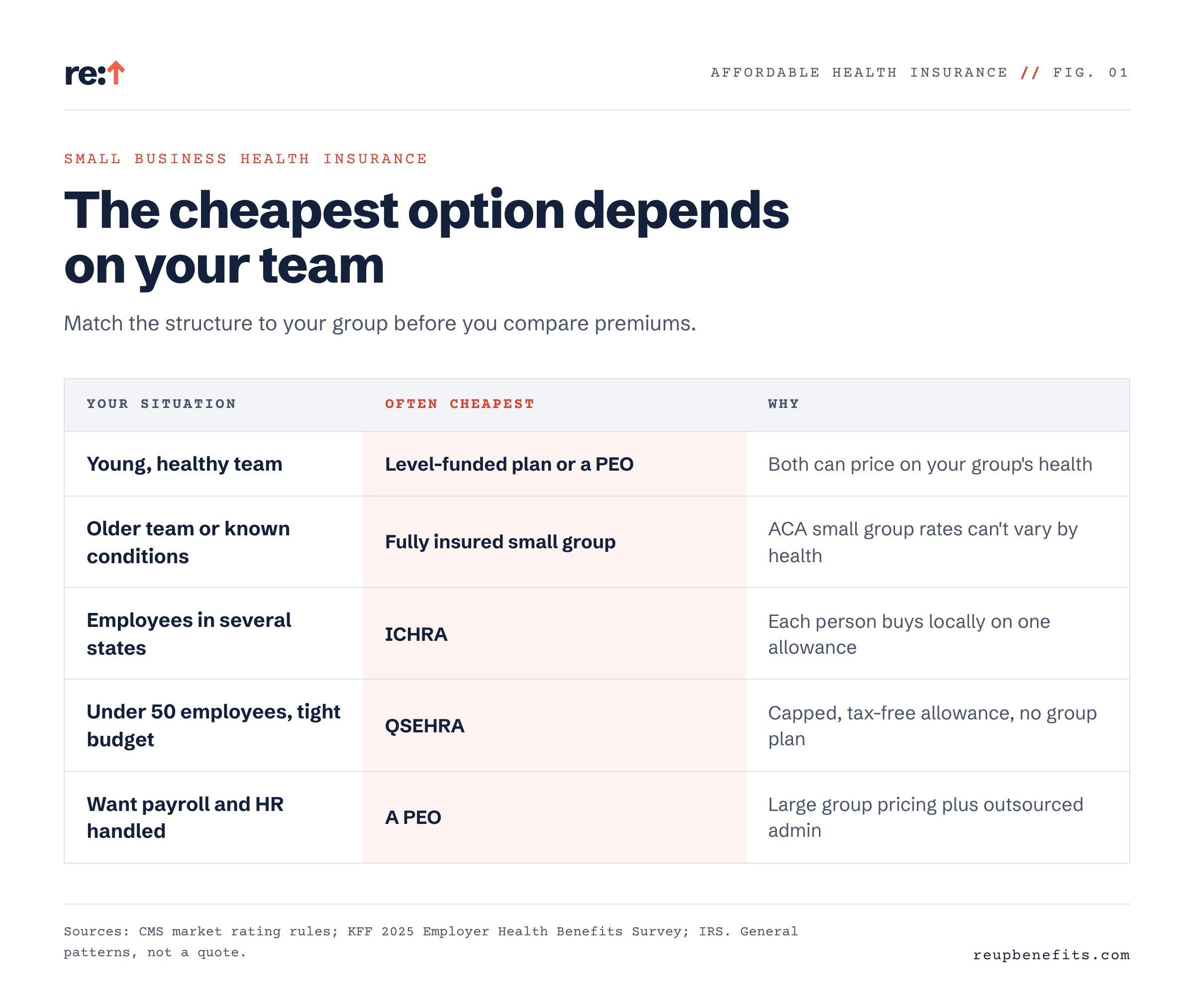
Our pillar guide explains how each option is underwritten, which is what drives these differences.
9 ways to get affordable health insurance for a small business
These are the levers that move the price the most. You won't use all nine, but most small businesses can use three or four.
1. Get priced on your group's health if your team is healthy
Level-funded plans and PEO plans can use your group's health to set the price. KFF found 37% of covered workers at firms with 10 to 199 workers were in level-funded plans in 2025. For a young, low-claims team, that can beat the small group rate. Our guide to PEO underwriting explains what PEOs look at.
2. Use community rating if your team skews older
In community-rated states like New York, where small group covers 1 to 100 employees, everyone on a plan pays the same rate regardless of age or health. An older team often gets its best price there, not in a plan that prices on health.
3. Set your contribution on purpose
Your contribution strategy matters as much as the plan. Covering a larger share of employee-only coverage, and a smaller share for dependents, keeps your cost predictable. Carriers usually require a minimum employer contribution, so confirm it before you set yours.
4. Pair a high-deductible plan with an HSA
An HSA-eligible plan usually has a lower premium. For 2026, it needs a deductible of at least $1,700 for self-only and $3,400 for family coverage, and HSA contributions are capped at $4,400 and $8,750. Putting part of the premium savings into employees' HSAs keeps the plan fair to them.
5. Use ICHRA or QSEHRA for a fixed budget
With an ICHRA, you reimburse employees tax-free for individual coverage they choose, and employers of any size can offer one. A QSEHRA is the simpler version for employers under 50 full-time equivalents that don't offer a group plan. For 2026, QSEHRA reimbursements are capped at $6,450 for self-only and $13,100 for family coverage (IRS Rev. Proc. 2025-32).
6. Check the small business health care tax credit
The IRS credit covers up to 50% of premiums for two consecutive years. You need fewer than 25 full-time equivalent employees, average wages under an inflation-adjusted limit, at least 50% of employee-only premiums paid by the employer, and coverage generally bought through the SHOP Marketplace. Ask your accountant whether you qualify.
7. Choose a network that fits your team
Narrower networks and HMO-style plans usually cost less. They only save money if your employees' doctors are in them, so check that before you switch.
8. Start shopping 90 to 120 days before renewal
In my experience, a late renewal is an expensive renewal. Starting early gives you time to quote other structures and negotiate with the incumbent. If you're on a PEO, our PEO renewal guide covers what to ask.
9. Compare at least two structures side by side
Quote the structure you have and at least one you don't, on the same census. That's the only way to know whether you're overpaying. Our comparison of the best PEOs for health insurance is a starting point if a PEO is one of them.
What makes small business health insurance expensive?
Small business health insurance gets expensive because of age, location, plan richness and, in some structures, claims. In ACA small group, rates can vary only by age, tobacco use, family size and location. In level-funded, self-funded and many PEO plans, your group's health and claims history can raise the price too. Our pillar covers what drives the cost of group health insurance in detail.
Two smaller factors trip up small employers. Carriers set minimum participation rules, and small teams can miss them when a few people waive. And a small group has less negotiating room at renewal, which is where comparing structures helps most.
Cheapest premium vs. lowest total cost
When small businesses shop for affordable health insurance, the cheapest premium isn't always the lowest total cost. Total cost is what the company pays in premium, plus what employees pay in premium, plus what they pay out of pocket when they use care.
Here is a hypothetical example for one employee with single coverage. The numbers are illustrative, not quotes.
| Hypothetical | Plan A: low premium | Plan B: higher premium |
|---|---|---|
| Annual premium | $7,000 | $9,000 |
| Deductible | $4,000 | $1,000 |
| Total if the employee barely uses care | $7,000 | $9,000 |
| Total if the employee meets the deductible | $11,000 | $10,000 |
Plan A wins for a healthy year and loses when someone gets sick. That's why the right choice depends on your team, and why a cheaper premium can still mean a worse deal for the people using the plan.
If you want to see which structure is actually cheapest for your team, book a 20-minute call with me. Bring your headcount, where employees live, a rough list of ages and your current invoice or renewal. I'll tell you which options are worth quoting.
Frequently asked questions about affordable health insurance for small businesses
What is the cheapest health insurance for a small business?
There is no single cheapest option. A young, healthy team often pays least with a level-funded plan or a PEO, an older team often pays least in a fully insured small group plan, and an ICHRA or QSEHRA caps your cost at a fixed allowance. Compare at least two on total cost.
How much does small business health insurance cost per employee?
KFF's 2025 survey put the average annual premium at firms with 10 to 199 workers at $9,211 for single coverage and $26,054 for family coverage. Employers paid most of it, and workers at those firms paid 16% of single and 36% of family premiums on average. Your price depends on ages, location and plan design.
Can a business with fewer than 10 employees get affordable health insurance?
Yes. Very small teams can buy small group coverage, join a PEO, or offer a QSEHRA or ICHRA, which have no minimum participation rules. Businesses with fewer than 25 full-time equivalent employees may also qualify for the small business health care tax credit.
Do small businesses have to offer health insurance?
Not under federal law if you have fewer than 50 full-time employees, including full-time equivalents. The ACA employer mandate applies only to applicable large employers. Many small businesses still offer coverage because it helps them hire and keep people.
Is a high-deductible plan a good way to save money?
It can be, if you pair it with a health savings account and put some of the premium savings into employees' HSAs. A high-deductible plan alone shifts cost to employees, which can hurt retention. For 2026, an HSA-eligible plan needs a deductible of at least $1,700 for self-only coverage.
Sources
This article is general information, not legal, tax or insurance advice. Rules and prices change and vary by state, so confirm details with a qualified advisor before acting. Figures are as of October 2026 unless noted.
- KFF: 2025 Employer Health Benefits Survey (October 22, 2025)
- IRS: Small Business Health Care Tax Credit and the SHOP Marketplace
- Paylocity: 2026 health FSA and other limits, citing IRS Rev. Proc. 2025-32 (October 10, 2025)
- HealthInsurance.org: Qualified small employer HRA (QSEHRA)
- Mercer: 2026 HSA, HDHP and excepted-benefit HRA figures (June 2025)
- CMS: Health Reimbursement Arrangements
- NY Department of Financial Services: small group expansion to 1 to 100 employees