
By Cesar Figueroa, Licensed Health Insurance & PEO Broker, ReUp Benefits
In this guide
How do you choose a PEO? Start with what your team needs, then compare PEOs on service model, employee support, technology, health plans, total cost and credentials. Get quotes from at least three using the same census, check IRS certification and ESAC accreditation yourself, and read the full contract before you sign.
Choosing a PEO is a bigger decision than it looks. The PEO you pick runs your payroll, sponsors your health plans and becomes the name your employees see on their pay stubs. NAPEO counts 502 PEOs serving about 233,000 clients (September 2026), and in a sales deck most of them sound the same.
I spent more than ten years inside three PEOs, including as an account executive and sales manager at Justworks, and I've watched good companies pick the wrong PEO for the wrong reason. This guide covers what actually separates them. If you're new to PEOs, start with our guide to what a PEO is in insurance.
What to decide before you choose a PEO
Before you take a single demo, decide what problem the PEO is solving. In my experience, the most common mistake is buying on the admin fee alone and finding out later that the service model was wrong.
Answer three questions first. Do you want someone to do HR for you, or a tool so you can do it yourself? Which states are your employees in, now and in the next two years? And what is driving the search: better benefits, less admin time, compliance worries or cost? Your answers decide which PEOs belong on the shortlist.
Which PEO service model fits your company?
There are three common PEO service models, and the right one depends on how much HR help you want from a person versus a platform.
Self-service platform. The software does most of the work, and you reach support by chat, phone or email when you need it. Justworks is the best-known example and lists 24/7 support on its PEO plans. It fits lean teams comfortable running HR from a dashboard.
Service center. You call or email a team rather than one person. Answers can be fast, but you may start over with someone new each time.
Dedicated team. You get named people who learn your business. Insperity, for example, describes a client liaison, HR specialist, payroll specialist and safety consultant for each client. This fits companies with frequent employee relations issues and no HR person in house, and it usually costs more.
What about onsite HR? In my experience, onsite visits are rare for small clients and usually come with a higher tier or a separate fee. If that matters, ask how often they visit and get it in writing. Also ask how many clients your HR contact handles. A great specialist stretched across too many accounts is not a dedicated team.

Will the PEO support your employees, or just you?
Your employees will use the PEO more than you will, so test their experience, not just yours. When an insurance card doesn't work at the pharmacy or a paycheck looks wrong, the PEO's employee support decides whether that becomes a five-minute fix or a complaint on your desk.
This is where Justworks built its reputation. Its PEO plans include 24/7 support and a mobile app for employees, and the PEO Plus plan adds health advocacy services, per its pricing page (October 2026). In my experience selling at Justworks, employee support was one of the biggest reasons clients stayed.
Ask every PEO: Can employees contact you directly, and how? What are your support hours? Is there a benefits advocate who helps with claim denials and billing problems? Then ask for the employee view in the demo, on a phone.
How to judge a PEO's technology and platform
Judge a PEO's platform by how easy it is for your least technical employee, not by the admin dashboard in the sales demo. Look and feel matter because a confusing platform turns every pay stub, PTO request and benefits change into a question for you.
Check five things: a real mobile app, employee self-service for pay stubs, W-2s and benefits changes, reporting you can export, integrations with your accounting, time tracking and applicant tracking tools, and whether the PEO owns its software. In my experience, many PEOs license the same white-labeled payroll platform, which works fine but means the product roadmap belongs to someone else.
For data security, ask for the PEO's SOC 1 Type 2 report. ESAC notes that a Type II report covers how internal controls actually operated over a period of time, which makes it more useful than a Type I.
What does onboarding look like with a PEO?
Onboarding with a PEO happens twice: once for your company and once for every employee, and both shape how the first year feels.
Company implementation. You send a census, prior payroll data and plan choices, then the PEO builds your account. Plan for several weeks. Start dates matter: joining a non-certified PEO mid-year can restart Social Security and unemployment wage bases, while a certified PEO generally avoids that. Ask who your implementation manager is and how many payrolls they stay with you.
Employee onboarding. On day one, every employee gets an invite to set up an account, enter tax and direct deposit details and enroll in benefits. Ask how long the enrollment window runs, whether employees can enroll from a phone, and whether the PEO hosts a live benefits meeting. For later hires, check that offer letters, I-9s and enrollment happen in one flow.
How to compare PEO fees
Compare PEO fees as a full cost per employee per year, not as an admin fee. ADP's own guide puts admin fees at 2% to 12% of payroll, or about $40 to $160 per employee per month. Justworks lists $79 and $124 per employee per month (October 2026).
Percent-of-payroll pricing rises with every raise and bonus, so push for a per-employee price if you pay commissions. Then add health premiums, workers' comp, state unemployment and add-ons. Our guide to average PEO fees for small businesses shows typical ranges, and our guide to PEO renewal explains why your year-two price matters more than your first quote.
Which PEO certifications matter?
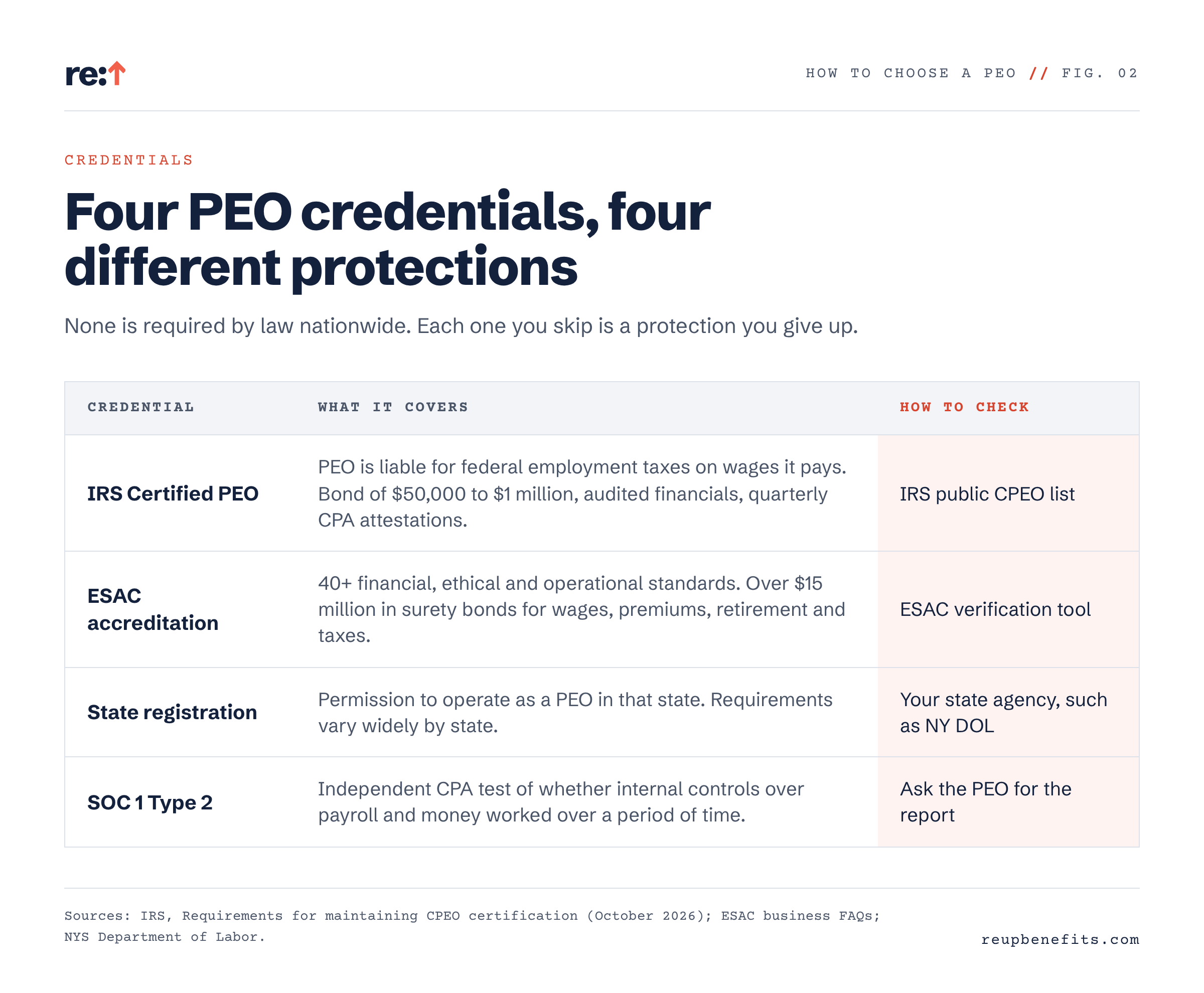
Four credentials are worth checking when you choose a PEO: IRS certification, ESAC accreditation, state registration and a SOC 1 Type 2 report. Each protects you from a different risk.
| Credential | Who grants it | What it covers | How to check |
|---|---|---|---|
| Certified PEO (CPEO) | IRS | The PEO is liable for federal employment taxes on wages it pays. It must post a bond of at least $50,000 (5% of prior-year liability, up to $1 million), file audited financials and submit quarterly CPA attestations. | IRS CPEO list |
| ESAC accreditation | Employer Services Assurance Corporation | More than 40 financial, ethical and operational standards, backed by more than $15 million in surety bonds for wages, premiums, retirement contributions and taxes. | ESAC verification |
| State registration or license | State agencies, such as the New York Department of Labor | Permission to operate as a PEO in that state. Requirements vary widely. | NY DOL PEO page or your state's agency |
| SOC 1 Type 2 report | Independent CPA firm | Whether the PEO's internal controls over payroll and money handling worked over a period of time. | Ask the PEO for the report |
The IRS details the bond, audit and quarterly attestation rules on its page on maintaining CPEO certification. ESAC says it has accredited PEOs since 1995 without a single accredited PEO default. Neither credential is required, and some solid PEOs skip one. Just know which protections you are giving up, and match the legal entity name on your contract to the list.
How to compare PEO health plans
The health plans are usually the biggest number on a PEO invoice, so compare them as carefully as the fees. Ask which carriers and networks cover each of your employees' ZIP codes, whether each plan is fully insured or self-funded, and whether the quote is firm or subject to underwriting.
Our guide to the best PEO for health insurance compares carriers by PEO, and our guide to PEO underwriting explains why the same team can be priced very differently. Hiring in New York? See PEO companies in New York.
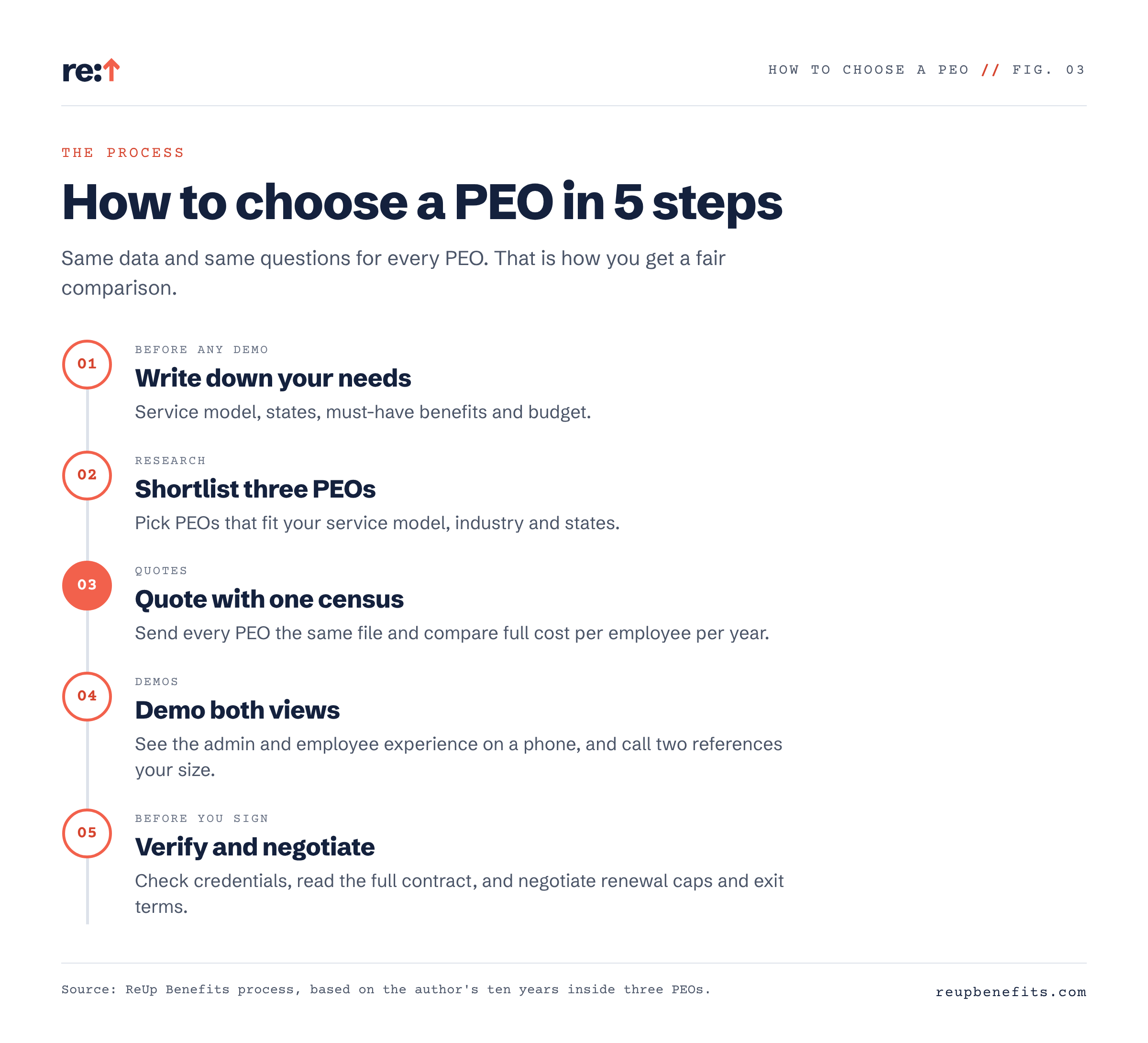
How to choose a PEO in 5 steps
Run every candidate through the same five steps, with the same data and questions.
- Write down your needs. Service model, states, must-have benefits and budget.
- Shortlist three PEOs. Our guide to the top PEO companies covers who each one fits. Startups can start with the best PEO for startups.
- Quote with one census. Send each PEO the same file and compare the full cost per employee per year.
- Demo both views. See the admin and employee experience, and call two references your size.
- Verify and negotiate. Check credentials, read the full contract and ask the 20 questions in our main guide before you sign.
Should you use a broker to choose a PEO?
You don't need a broker to choose a PEO, but a good one saves time and money. A PEO broker sends one census to several PEOs, lines the quotes up side by side and negotiates the contract on your side of the table.
I'm a licensed health insurance and PEO broker, so I can also quote group health options outside a PEO.
If you're choosing a PEO or wondering whether yours still fits, book a 20-minute call with me. Bring your current invoice or any PEO proposals you have, plus a rough employee list, and I'll show you how the options compare.
Frequently asked questions about choosing a PEO
What is the most important factor when choosing a PEO?
Fit between the PEO's service model and how your company wants to run HR. Price matters, but a cheap PEO that leaves your employees without answers costs you more in turnover and founder time. Decide the service model first, then compare price within it.
How many PEOs should I get quotes from?
At least three. Send each one the same employee census so the quotes are comparable, and compare the full cost per employee per year, not just the admin fee.
Is a certified PEO better than a non-certified PEO?
A certified PEO (CPEO) takes on liability for federal employment taxes on the wages it pays, and it must post a surety bond and file audited financial statements with the IRS. That is real protection. A non-certified PEO can still be a good partner, but you keep more of the federal tax risk.
What is ESAC accreditation for a PEO?
ESAC, the Employer Services Assurance Corporation, is an independent accreditation body for PEOs. Accredited PEOs meet more than 40 financial, ethical and operational standards and are backed by more than 15 million dollars in surety bonds. You can verify any PEO's accreditation on ESAC's website.
Can I switch PEOs if I choose the wrong one?
Yes, but every plan moves at once: health, workers' comp, 401(k) and payroll. Check the notice period and termination terms before you sign, and plan a switch around your renewal date so employees don't restart their deductibles mid-year.
How long does it take to set up a PEO?
Plan for several weeks from signed agreement to first payroll, depending on underwriting and your start date. January 1 or your current health plan renewal date are usually the cleanest start dates.
Sources
This guide is general information, not legal, tax or insurance advice. Rules and PEO offerings change, so confirm details with each provider or a qualified advisor. Figures are as of October 2026 unless noted.
- NAPEO: Industry research and data (updated September 2026)
- IRS: Requirements for maintaining certification as a CPEO (October 2026)
- IRS: CPEO public listings
- ESAC: Business FAQs about PEO accreditation
- ESAC: The value of accredited PEOs
- NYS Department of Labor: Professional Employer Organizations
- ADP: What is the cost of a PEO?
- Justworks: Pricing (October 2026)
- Insperity: HR solutions and service team (October 2026)